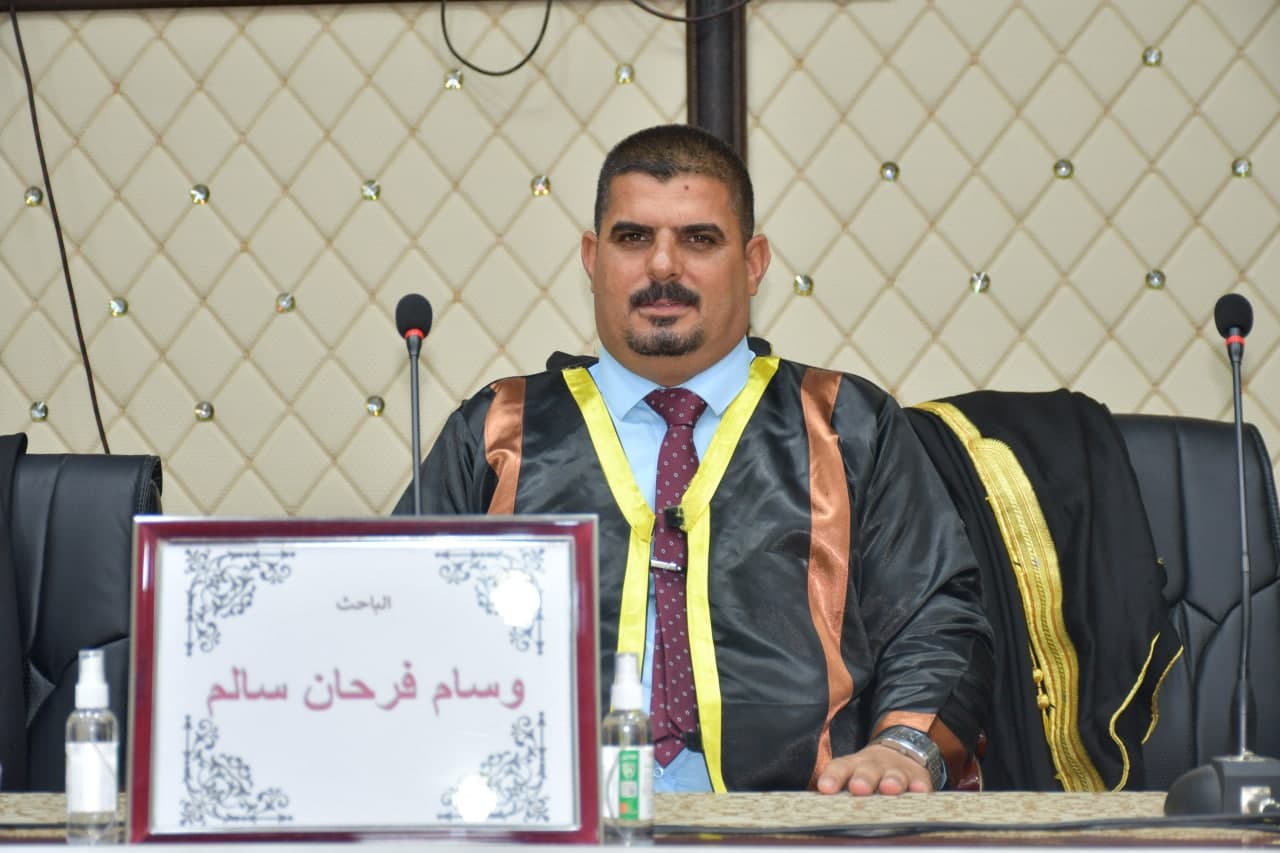
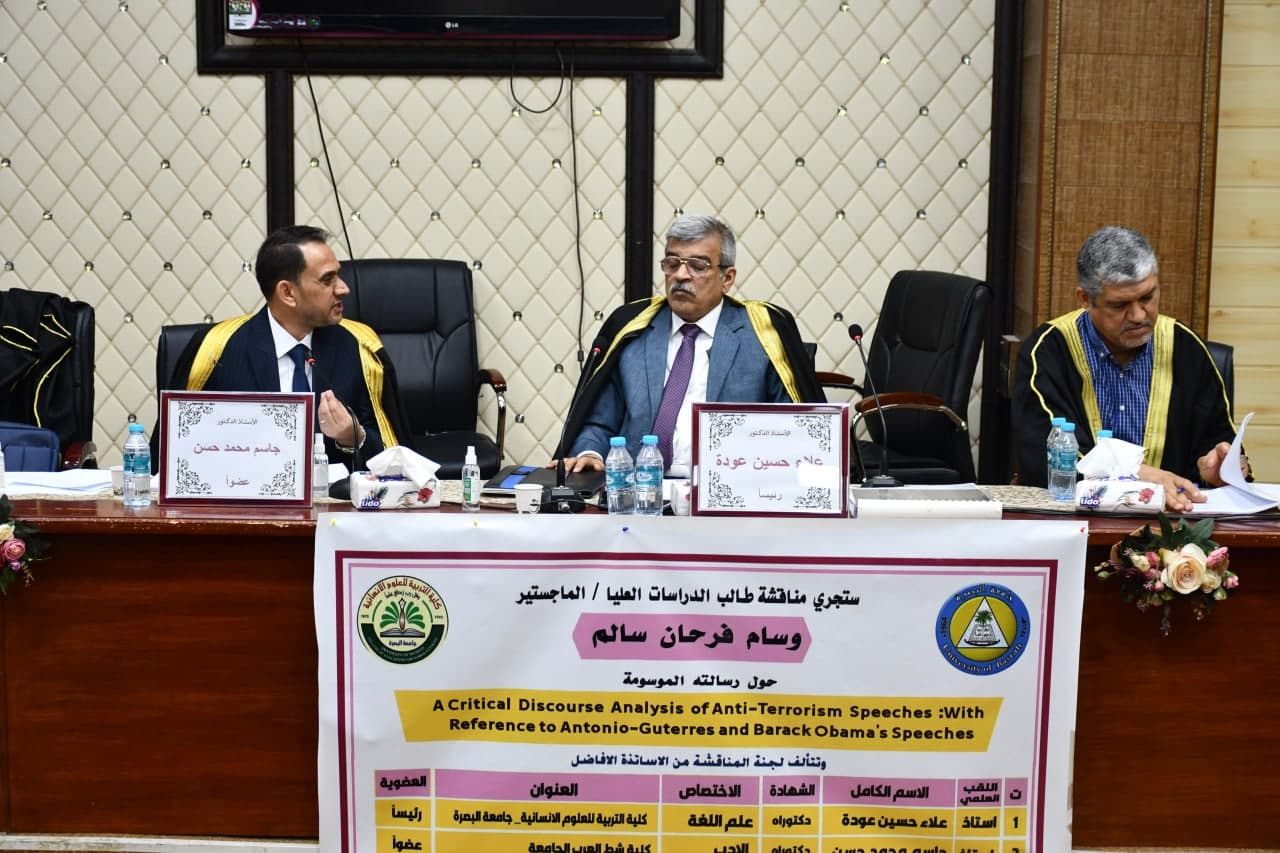
The thesis has been discussed at the Department of English , College of Education for Human Sciences ,University of Basrah.
Abstracts
This study aims to use Critical discourse Analysis and adopts Fairclough’s model (1989) to study anti-terrorism speeches. Two speeches of anti-terrorism are selected to be studied(The speech of the secretary-general of the united nation Antonio Guterres and Barack Obama on anti-terrorism. The thesis attempts to illustrate the power, ideologies and identities that reenacted in anti-terrorism speeches. The study also gives an interpretation for the text and context through situational context, intertextuality and speech acts. This thesis additionally aims to investigate power struggle , social struggle and political struggle in the text. Discursive practices and social practices are also investigated in these texts .The study also investigates discourse type of these texts and power.
Thesis outline
The study is divided into five chapters: The first chapter gives a preliminary view of the study. It presents the aim, the objectives, and the significance of the study. Chapter one also includes the procedures of the study, it includes also a review of the literature. Chapter two presents the concepts of discourse and discourses. It gives specific definitions of the concept of discourse analysis. This chapter gives explanations and details of the concept of critical discourse analysis. Chapter two also deals with the relation of discourse and terrorism, discourse and counter-terrorism, discourse and ideology, discourse and gender and discourse and power. The theoretical Framework of the analysis is presented in chapter three of this study. It provides a detailed overview of Fairclough's three-dimensional model (1989), which is used to examine anti-terrorism speeches. Data analysis is the focus of chapter four.
Conclusions
The present study arrives at the following conclusions:
2. Anti-terrorism is a battle that is led by good leaders in the world, good politicians and human rights representatives. The main techniques in this battle are ideologies: counter-terrorism ideology, equality ideology, religious freedom ideology .
3 . language power is used to achieve many tasks. It is used to command people to fight terrorism. It is used to order people to follow some procedures to take down terrorist groups. It is used for advice and to warn people of the dangers of terrorist groups.
4. Social struggle, political struggle and power struggle are expressed by using language. The differences of struggles mainly depend on the relationships between the speaker and participants at the societal and situational level.