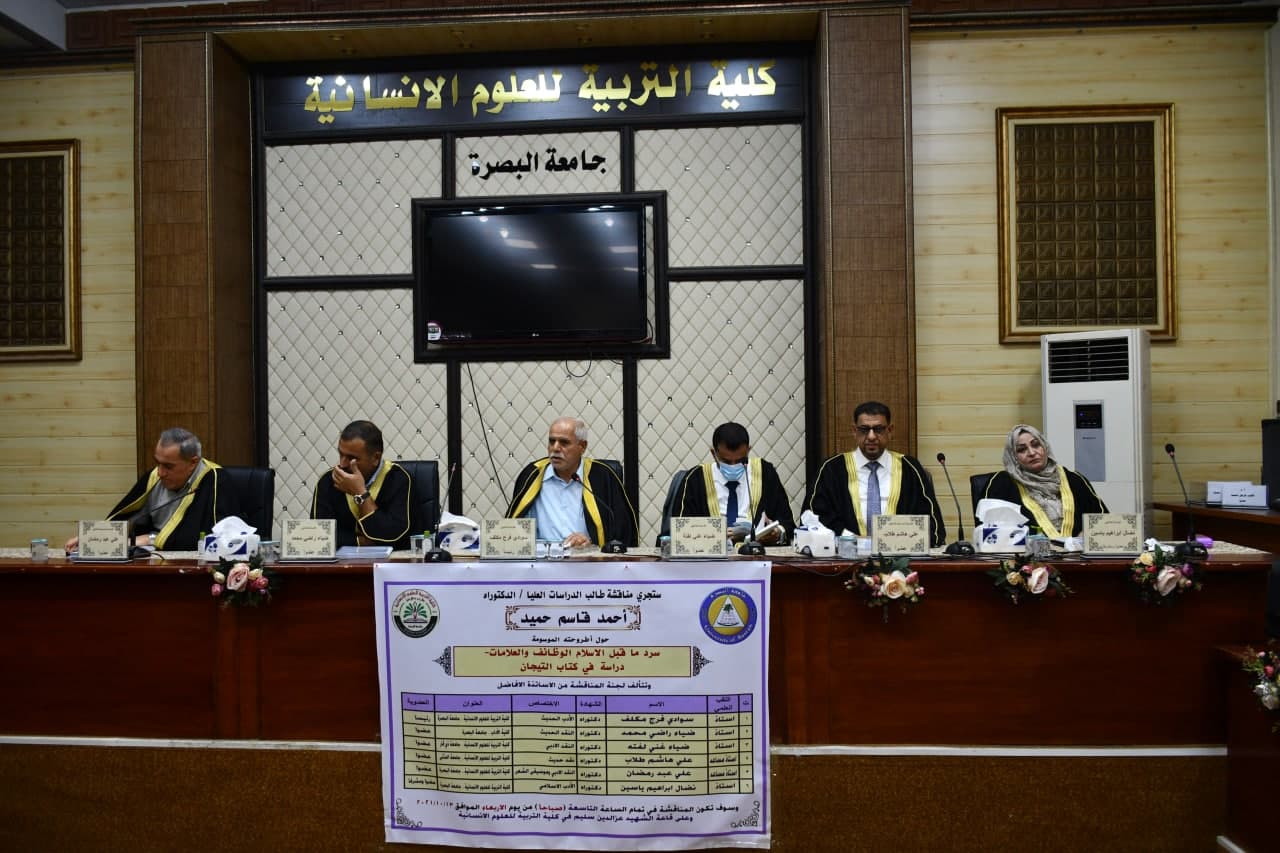
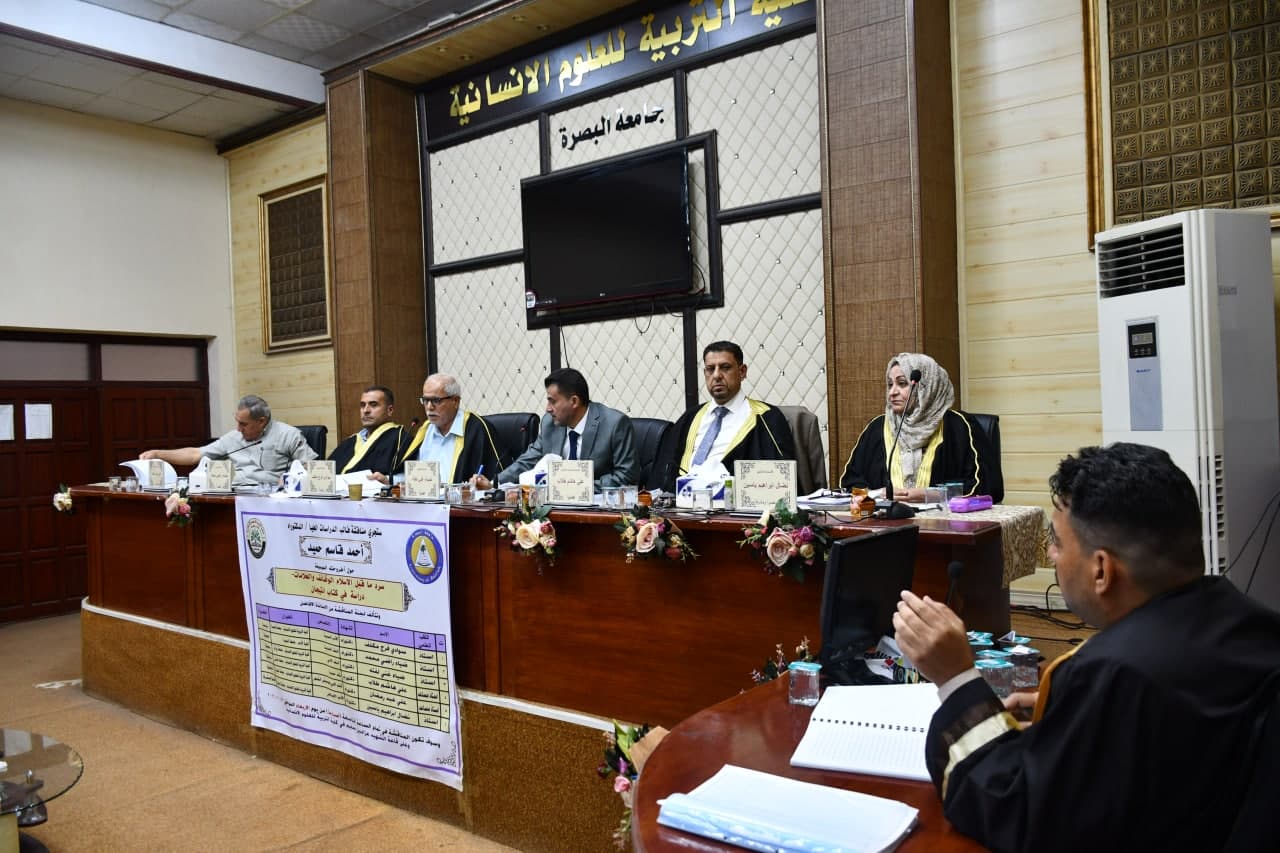
Doctoral thesis at the University of Basra discusses ((The Book of Crowns by Wahb Ibn Munabbih - A Study of Jobs and Marks))
Doctoral thesis in the Department of Arabic Language / College of Education for Human Sciences / University of Basra - ((The Book of Crowns by Wahb bin Munabbih - A Study of Functions and Marks)) by student Ahmed Qasim Hamid
The thesis dealt with questions that reveal the effectiveness of the news and discourses that it will constitute by reproducing texts that have undergone a set of changes, through their movement in a historical path, from their oral framework to written record. And how it affected the formulation of that heritage produced through it. The thesis aims to reveal exemplary news from the book of crowns, by specifically begging the semiotic method and using the narrative program to determine the paths of the transformation of the personality from its social status to the active and then the global in order to achieve the central function in it.
The thesis concluded that dealing with written narratives and news, as a threatening factor for the emergency knowledge theory on Arab awareness, which gave him the Arab-Islamic identity, an identity composed of the factor of affiliation and religion, and this constituted an aspect of concern and weakness in the body of that relatively emergency identity at that time. In spite of the re-writing and formation of the Arab heritage within the framework of a written discourse, and the introduction of a new form by formulating that heritage in authoritative systems (books and manuscripts), we find the absence of oral mechanisms and tools in the codification process? Because the act of informing retains its efficacy and identity, as it is an oral procedure based on a duality (narrating/listening). And his reduction of those narratives as a central function that provided expressive mechanisms that maintained their effectiveness even after their transformation into the written one. And the actual presence of the novel and the codification and their overlapping in the same era in the codification process. The exact description of the process of codification of the Arab heritage that took place in the middle of the second century AH; It is the transformation of oral texts into written texts, through an unstable and clearly defined notation system, due to the lack of neutral procedural mechanisms and a mature and integrated written awareness that expresses the true identity of the pre-Islamic Arab society. Although historical honesty is what the writing process aimed at, by reproducing central religious texts, which later expressed the concept of Arab-Islamic identity, avoiding the dispensation of the imagined news from the attribution mechanism with the structure of the imagined news text deviating towards the satirical parodies, declaring itself an independent narrative structure By itself, it does not share with the historical news except as a historical inheritance. The presence of harmony between the grammatical and semantic structure in the title text, and giving it connotations that earned it its independent identity and its own poetry. The title (Crowns in the Kings of Donkeys) is a linguistic structure that met criteria for text grammar, and shared with other texts of the book in structural and semantic relations, through the concept of the grand structure. And being a sentence with a grammatical criterion, and a text with multiple criteria. The process of arriving at the meaning in the text of the title can only be achieved in the hermeneutic aspect through the availability of linguistic semantic (intertextual) relations between the structure of the title and its subject, in contrast to the lack of it in Ibn Munabbih’s supposed title as a reference structure and an abstract semantic space. A codification system based on a set of textual structures as an output system for the codification process of the Arab Islamic heritage.