
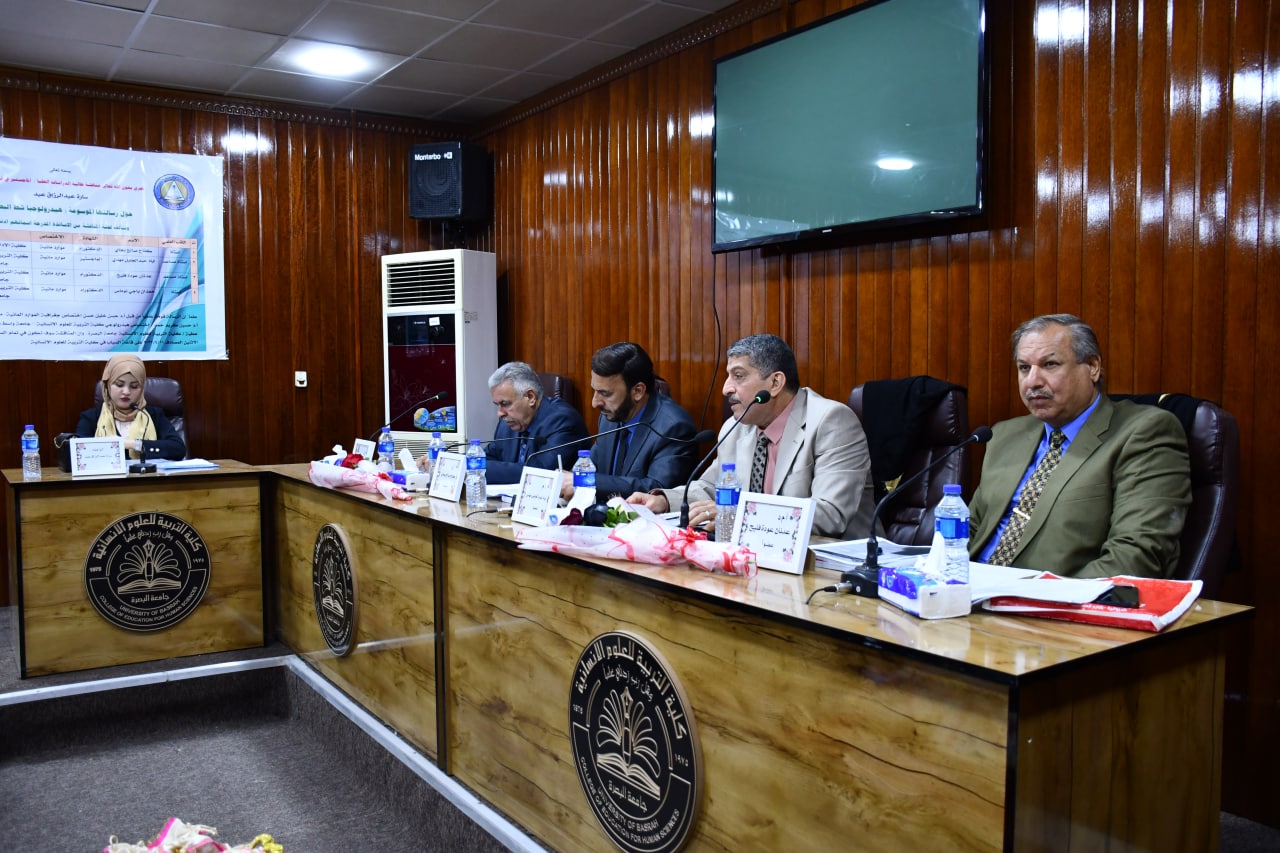
 I researched a master's thesis in the Department of Geography - College of Education for Human Sciences - University of Basra Hydrology of Shatt al-Basrah (Sarah Abdel-Razzaq)
The thesis dealt with the hydrology of the Basra Shatt, and the research included the natural and human characteristics of the study area and their role in influencing the Basra Shatt Canal. Collecting water samples for different locations of the Basra Shatt, three samples during the summer and three samples during the winter to identify the reality of the hydrochemical system of the Basra Shatt water, as well as determining the environmental importance of water and the possibility of investing it in several fields.
The study included four chapters:
The first chapter specializes in clarifying the natural characteristics of the study area, which are represented in (location, geological structure, surface, climate, soil, ground water and natural vegetation) and human characteristics, which included (the impact of the upper basin projects, pollution with sewage water, industrial, agricultural),
The second chapter deals with the clarification of the hydrological characteristics of the Basra river and its temporal and spatial variation.
As for the third chapter, it included the qualitative characteristics of the waters of the Basra Shatt and knowing their temporal and spatial variations and their suitability for different uses.
While the fourth chapter included an assessment of the water and environmental investments of the Basra Shatt, which included (the importance of investing the Basra Shatt in the reclamation of agricultural lands, the possibility of investing the Basra Shatt in agricultural irrigation, river transport, fisheries development, tourism, sand dune stabilization, reviving the marshes, desalination, ward off the dangers of flooding)
The most important results of the study were as follows:
The Shatt al-Basra is administratively located in the province of Basra within the lands of the sedimentary plain, and it starts from the Hamar marsh in the north and ends with Khor al-Zubayr in the south.
Shatt al-Basra constitutes the southern part of the general estuary drainage, and its implementation began in 1970 and was completed in 1983. Its length is about (38 km) and its width at the bottom is (59 m), and it is affected by tidal waves from the Arabian Gulf through Khor Al Zubair, its slope rate is about 5 45 cm/km) and a depth of 3.5 m. The rate of discharge is about (50.6 m3/s), but its design capacity is (500 m3/s), and it is affected by tidal waves from the Arabian Gulf through Khor Al Zubair, and it controls the drainage of The water regulator Shatt al-Basra, which is (22 km) from the entrance to the Shatt al-Basra and (15 km) from the upper approaches to Khor al-Zubayr,
The evaluation of the hydrological characteristics and water investments of the Basra Shatt showed that the water resources were affected both quantitatively and qualitatively by the natural and human characteristics of the study area. It is also affected by salty sea water coming from the Arabian Gulf.
It was found by studying the hydrological characteristics of the Basra River that the annual, seasonal, and monthly discharge and levels varied.
By studying the qualitative characteristics of the Basra Shatt water and the possibilities of its use, it was found that they vary in time and space, and in general it became clear that they change in the direction to the south.
In general, we conclude that the qualitative characteristics of the water of the Basra Shatt are high in all study stations and that it is not suitable for human use for drinking water, the aquatic environment and agricultural uses, but it is suitable for the purpose of animal consumption and becomes poor in the south of the study area as a result of the effect of sea water due to tidal waves coming from the Arabian Gulf and the lack of water drainage.
It became clear from the evaluation of the water and environmental investments of the Basra Shatt how important it is in the reclamation of agricultural lands in the region, through which the saline drainage water is transported and put to the Arabian Gulf. And he averted flood warnings and other water investments that would contribute to solving the water crisis afflicting the region.
