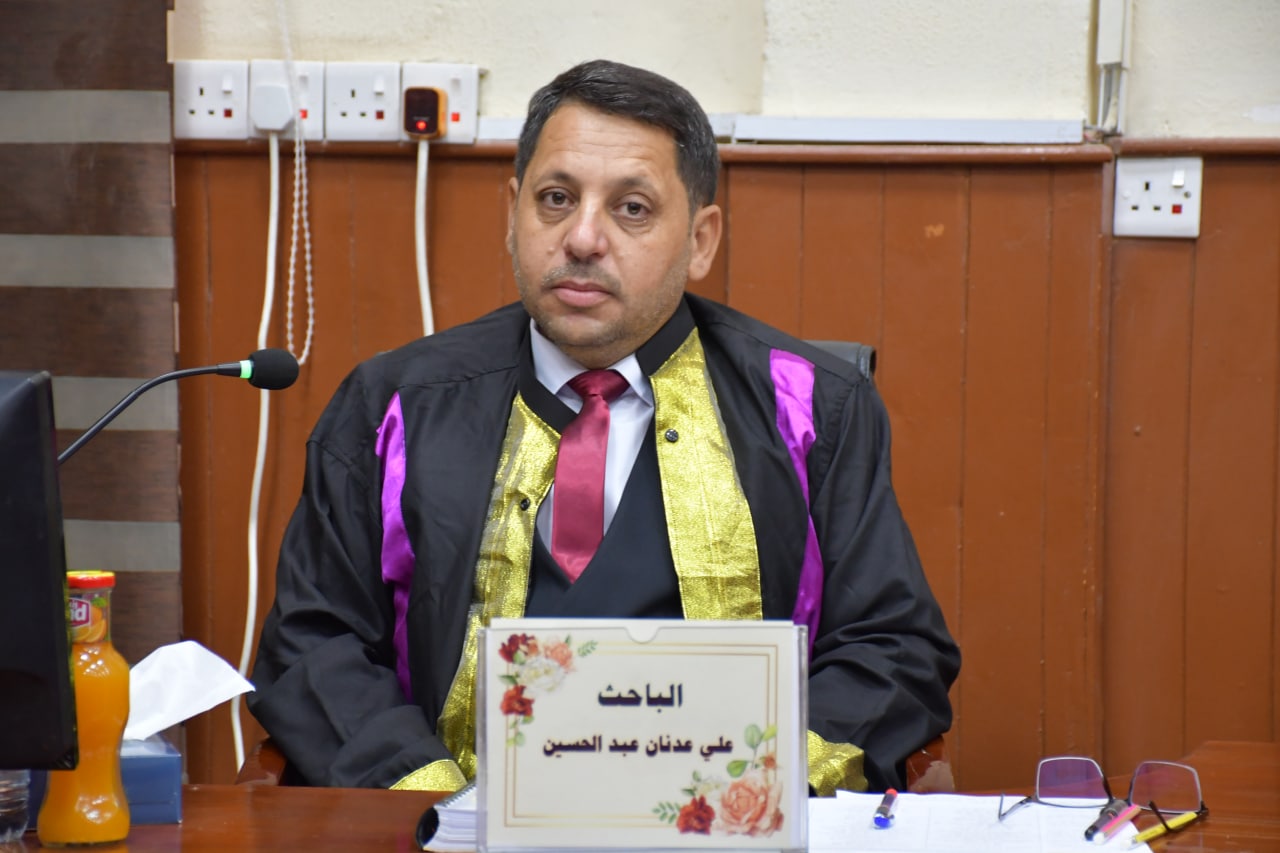
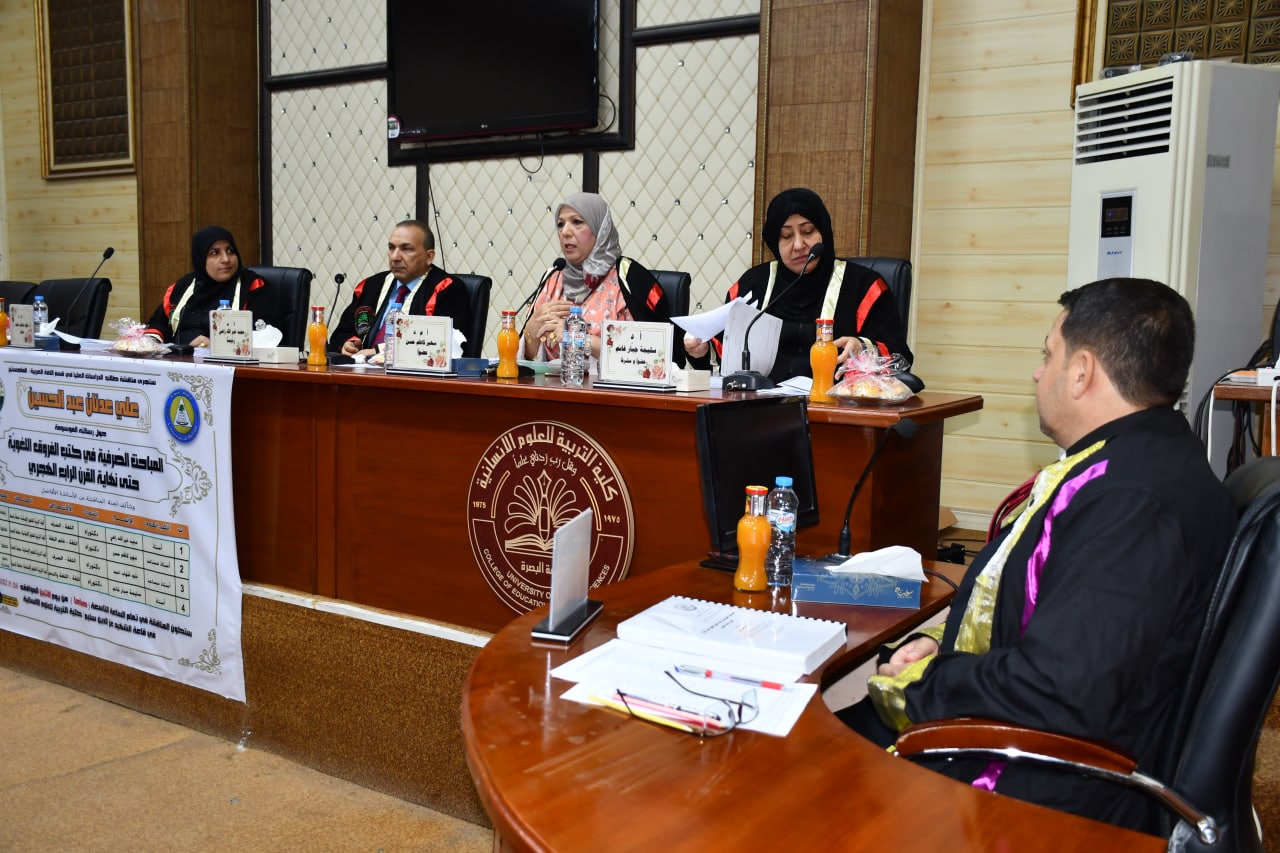
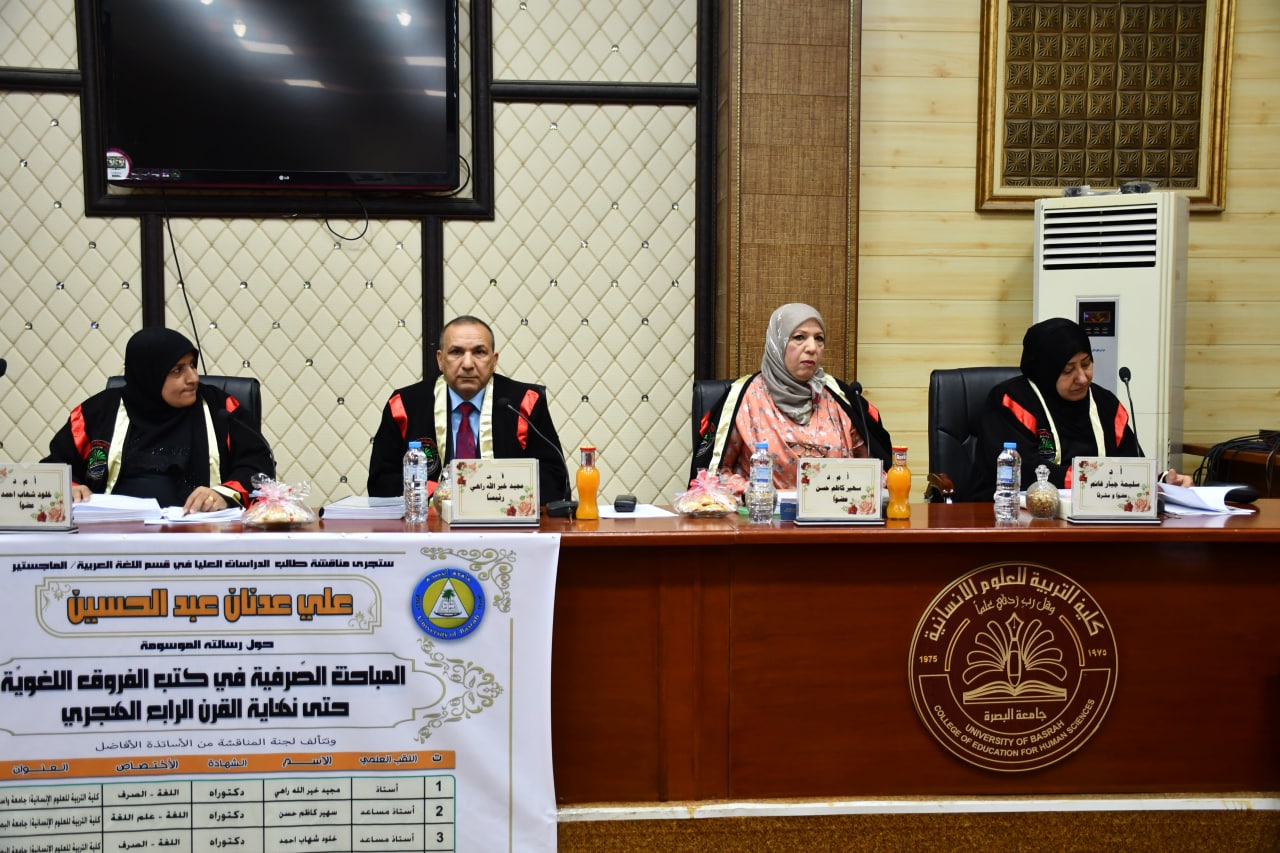
Master's thesis in the Department of Arabic Language / College of Education for Human Sciences / University of Basra - morphological investigations in the books of linguistic differences until the end of the fourth century AH - by the student (Ali Adnan Abdul-Hussein) under the supervision of Professor Dr. (Salima Jabbar Ghanem)
The thesis dealt with morphological investigations in the books of linguistic differences until the end of the fourth century AH. The study was divided into six books: Al-Farq by Qatrib (died 210 A.H.), Al-Farq by Al-Asma’i (died 215 A.H.), Al-Farq by Al-Sijistani (d. 255 A.H) and Al-Farq by Thabit (T.: T.: 276 AH) and Al-Farq by Ibn Faris (died: 395 AH) and linguistic differences by Al-Askari (died: 395 AH). The research included four chapters preceded by an introduction and preface, followed by the most prominent results and a list of sources and references.
The thesis aims to present the morphological material of the owners of linguistic differences that distinguished their books and to reveal the morphological investigations that dealt with the words and the way their authors treat those words and the points of convergence and divergence between the owners of the differences themselves and the rules and provisions approved by the language books. Investigations either by declaring or by suggesting the morphological material
The thesis concluded that the linguistic differences books - the subject of the study - are small in size, but they are rich in terms of treatment of the term origin, nomenclature, derivation, sources of all kinds, plurals, as well as verbs. Or what was approved by language or poetry and others, which removes its ambiguity, and the books of linguistic differences enjoyed a unique position in the lexical field, as it is correct to express semantic dictionaries because they contain abundant linguistic material, as the study showed about the superiority of Qatrib and fixed in the large number of words and the multiplicity of treatments. As for Al-Asma’i and Al-Sijistani, they Their treatments were dominated by a kind of abbreviation in most of their treatments. As for Ibn Faris, his book was distinguished by its abbreviation in the treatment of words. As for Al-Askari, his book distinguished the differences in an educational way in most of its treatments. Sometimes we find him mentioning the morphological rule and then applying his treatment according to the rule or in violation of it.