Basrah - College of Pharmacy Media:
Dr. Zainab Toamah Khalaf, a faculty member at the College of Pharmacy, University of Basrah, published a research paper titled "Cloning and Transformation of the Human Glucocerebrosidase Gene in Agrobacterium tumefaciens LBA4404" in the Bangladeshi International Journal of Biosciences. The journal has an impact factor of (0.5) and is indexed in Scopus and Thomson Reuters.
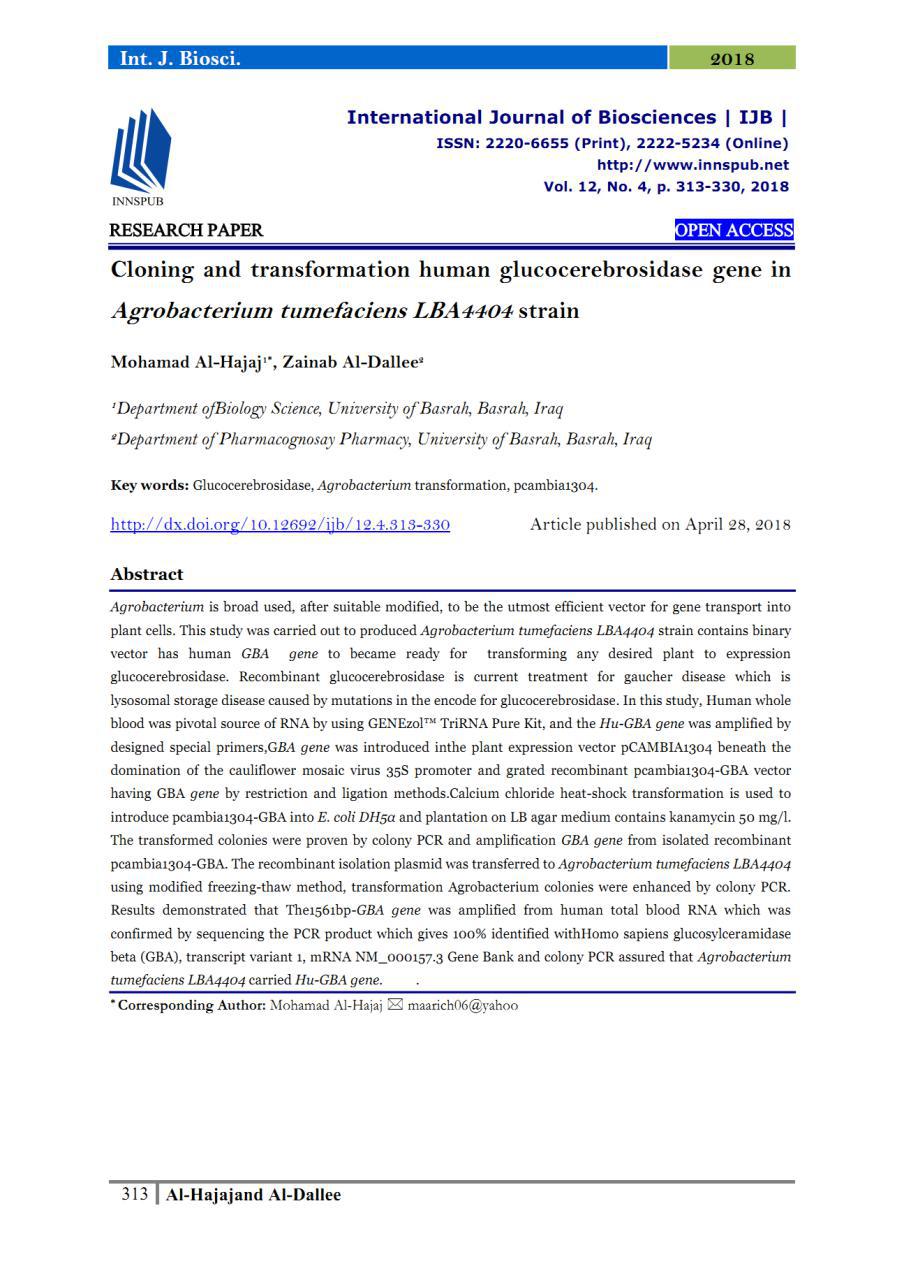
The study included the production of Agrobacterium tumefaciens strains containing a plasmid carrying the human GBA1 gene, making them ready to transform any desired plant for the expression of the glucocerebrosidase enzyme. The recombinant glucocerebrosidase enzyme is the current treatment for the genetic disorder Gaucher disease, which is caused by genetic mutations in the gene responsible for encoding this enzyme.
Human blood was the source of RNA using the GENEzol TriRNA Pure Kit, where the human Hu-GBA gene was amplified by designing specific primers and using PCR technology. The results confirmed obtaining an amplified gene with a length of 1561 bp. The amplified GBA gene was inserted into the plant cloning vector pCAMBIA1304, and then the recombinant plasmid pCAMBIA 1304-GBA was introduced into E. coli DH5α bacteria and cultured on LB agar medium containing 50 mg/L kanamycin.
The transformed colonies were confirmed using the Colony PCR method, and the recombinant plasmid pCAMBIA1304-GBA was isolated from the transformed bacteria. Subsequently, the isolated recombinant plasmid was transferred to A. tumefaciens LBA4404 bacteria. The study aimed to produce modified Agrobacterium tumefaciens LBA4404 bacteria carrying the human GBA gene, which is responsible for producing the human glucocerebrosidase enzyme used as a treatment for the genetic Gaucher disease.
❧ ☙
