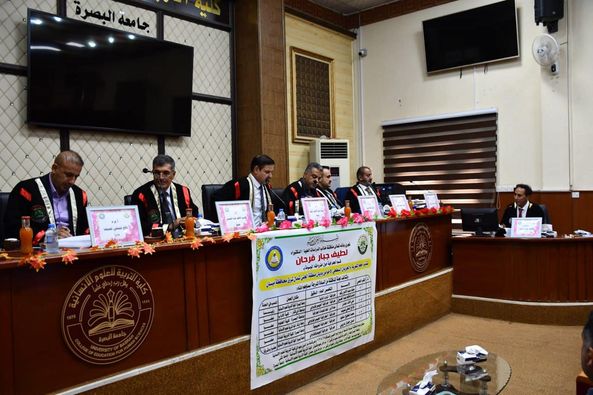
The study dealt with: the basins and valleys of the Al-Jana region of the border basins between Iraq and Iran, which are located in Adria in the north-east of Maysan Governorate and originate from within Iranian territory, as it enters the Iraqi borders at the Al-Jana border post towards the southwest to flow into the Sarout Horus, which is close to the Tigris River, and that the goal of The study to find out the quantities of soil lost in the region, to identify the areas most exposed to erosion or erosion, and to estimate the volume of surface runoff as an influencing factor in the occurrence of soil erosion processes.
The study aims:
To know the amount of erosion of both types (water and wind) and surface runoff in the basins and valleys of the Al-Jana area, and to know the natural characteristics such as geological structure, elevation and slope, and to study the climatic elements, water resources, soil and natural vegetation, as well as to identify the most important geomorphological processes and the forms resulting from them, and then to address the morphometric characteristics of basins and networks discharge in the study area.
Conclusions:
- The basins and valleys of the Jana region stem from the Iranian highlands at their upper sources in the northeastern part, to enter the Iraqi lands towards the south and southwest, and contain the main basins, which are the basins (Al-Matih, Al-Jana, and Al-Dabaa). These valleys, with their branches, form a water drainage network.
- It was found through the application of the Bergsma equation to calculate water erosion in the basins and valleys of the study area, as it notes a slight variation in the rates of erosion, as it reached the highest rate of erosion, which was classified within degree (6) in the Wadi al-Dabaa basin, with an area of (2.16). km and a percentage of (35.25%) of the total area of the basin.
- When applying the (Chepil) equation to estimate the size of wind erosion on the stations of the study area, as they were classified within the very high erosion range, due to the lack of vegetation cover, high rates of drought and the impact of depressions on the region.
- Rusle's model was able to classify the study area for water erosion calculation as having very weak erosion, due to the region's location within dry and semi-arid climatic regions, lack of precipitation, and its decline in plain to flat areas. As well as to the type of soil that is characterized by low soil content of soil commodities and its poverty in organic matter.
- The water harvesting technique was employed in areas that fall under dry conditions, and benefited from it in various investments
For the purposes of irrigation, agriculture and the development of lands with unsuitable land cover.
- It was found from the study of the water balance of the basins and valleys of the Al-Jana region and from the results of the Ivanov equation that it is affected by the amount of water loss by evaporation on the amount of surface and groundwater, by defining two main chapters: the water surplus season and the water deficit season, as we note that the water deficit season, i.e. the value of evaporation, is superior to Calculating the amount of rain.
- Through the study, the volume of surface runoff was estimated by using the values of the curve or soil maintenance or on the hydrological soil group that represents the land cover to calculate the amount of discharge in the valleys, and the possibility of investing the region in generating surface water runoff.
Recommendations:
- The need to invest surface and groundwater through the construction of dams at the feet of the highlands to harvest water during the rainy season in order to avoid the risks of torrential rains and floods and reduce water erosion processes and benefit from the water retained in feeding the underground storage and to increase the vegetation cover
Monitoring and monitoring the erosion manifestations that the area is exposed to on a regular basis, using modern technologies, to ensure its protection and maintenance, and work to raise the level of the degraded area.
- The researcher recommends conducting more studies related to surface runoff in the region and reducing its dangers.
- Work on establishing hydrological stations to measure the volume of discharge in the region to know the fluctuation in the water level during the different seasons.
- The researcher suggests establishing climatic stations to provide the necessary data, especially with regard to measuring the amount of rain or the volume of surface runoff.