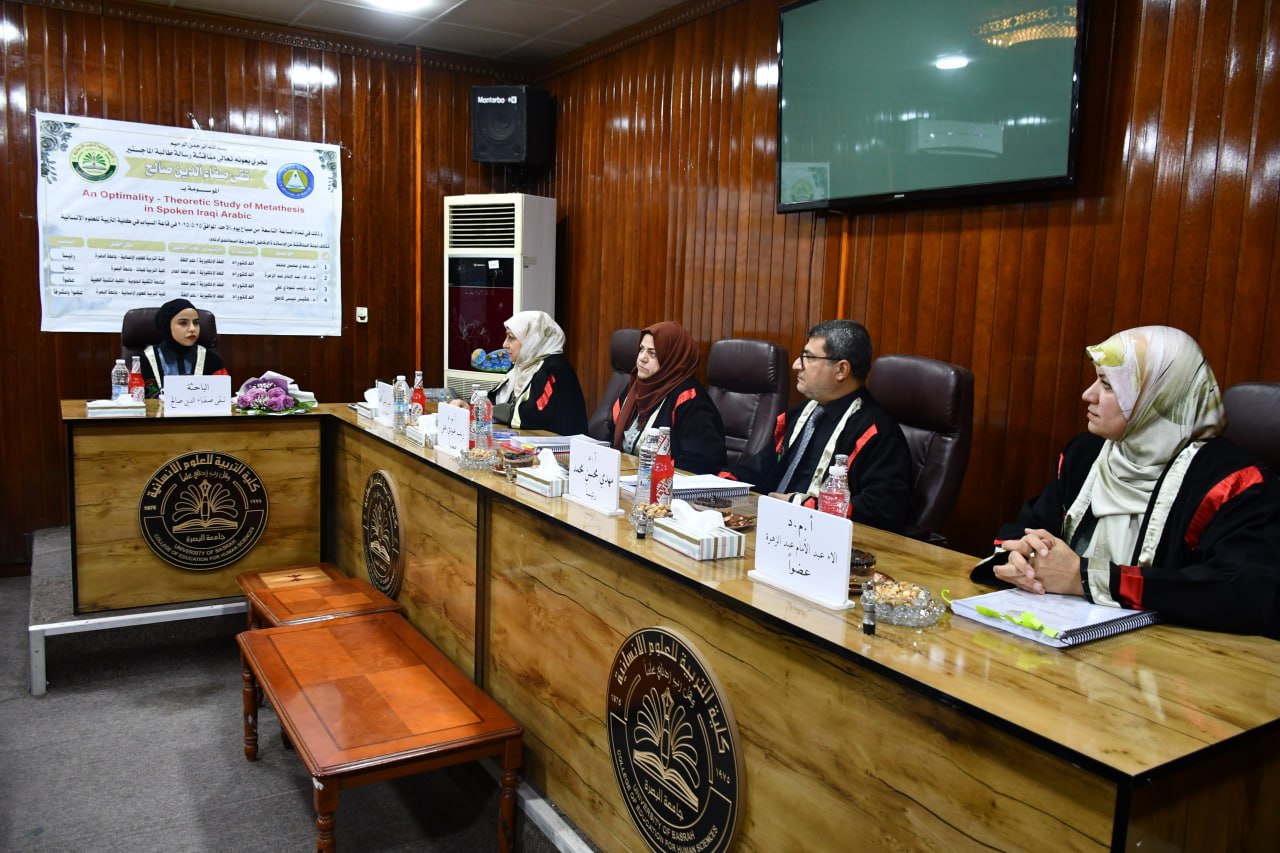
A master's thesis at the College of Education for Humanities at the University of Basra examined the phenomenon of phonetic spatial inversion in spoken Iraqi dialect according to the differential linguistic theory. The thesis, presented by student Taqa Safaa al-Din Saleh, aims to demonstrate the success of the differential linguistic theory in explaining the phenomenon of phonetic spatial inversion in spoken Iraqi dialect, as well as to identify the constraints that have the most significant impact on its stimulation. It also examines the effect of constraints related to sonority in explaining this phenomenon, and investigates whether it occurs independently or in conjunction with other phonetic processes. Furthermore, this study investigates whether this phenomenon is more common in monosyllabic or polysyllabic words, identifies the grammatical category in which it occurs most frequently, and identifies the sounds most susceptible to spatial inversion. The results demonstrate that the differential linguistic theory is capable of explaining the phenomenon of phonetic spatial inversion in spoken Iraqi dialect, explaining the reasons for its occurrence and the reason for its preference over other phonetic strategies. The analysis showed that the need to satisfy higher-order constraints—including sonority constraints, onset and coda restriction constraints