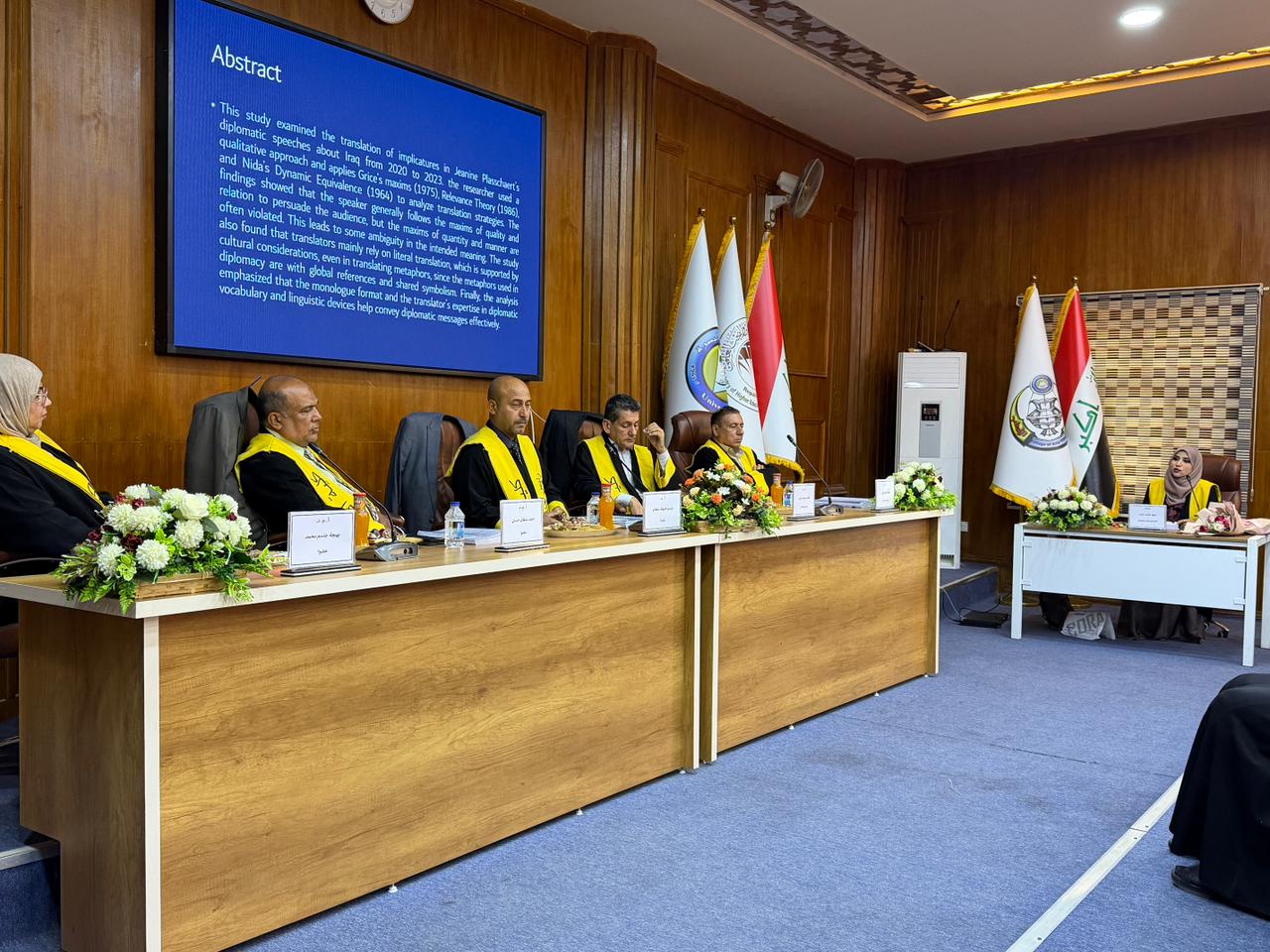
.jpeg)
A Master’s thesis in the Department of Translation, College of Arts, at University of Basrah examined “The Translation of Implicit Meanings in Diplomatic Discourse: A Study of Jeanine Plasschaert’s Speeches on Iraq.”
The thesis, submitted by researcher Shahad Mohammed Sabbar, aimed to identify the challenges translators face when rendering implicit meanings in diplomatic discourse and to determine the translation strategy most frequently employed in translating such meanings.
The study adopted a qualitative approach to analyze selected samples and their translations. It utilized Eugene Nida’s Dynamic Equivalence Model (1969) to assess translation quality, as well as H. Paul Grice’s Maxims (1975) and the Relevance Theory (1986) to examine the influence of context on the interpretation of diplomatic messages.
The thesis concluded that Jeanine Hennis-Plasschaert frequently violates the maxims of manner and quantity while adhering to the maxim of quality and providing information that is relevant to the context.
The study further revealed that literal translation is the most commonly used method for conveying implicit meanings, even when metaphors are involved, as these often carry universal connotations. Moreover, the research found no significant translation difficulties, since diplomatic speeches are typically translated by professional translators who possess extensive linguistic competence and diplomatic expertise, as well as sufficient knowledge of both the source and target languages.
