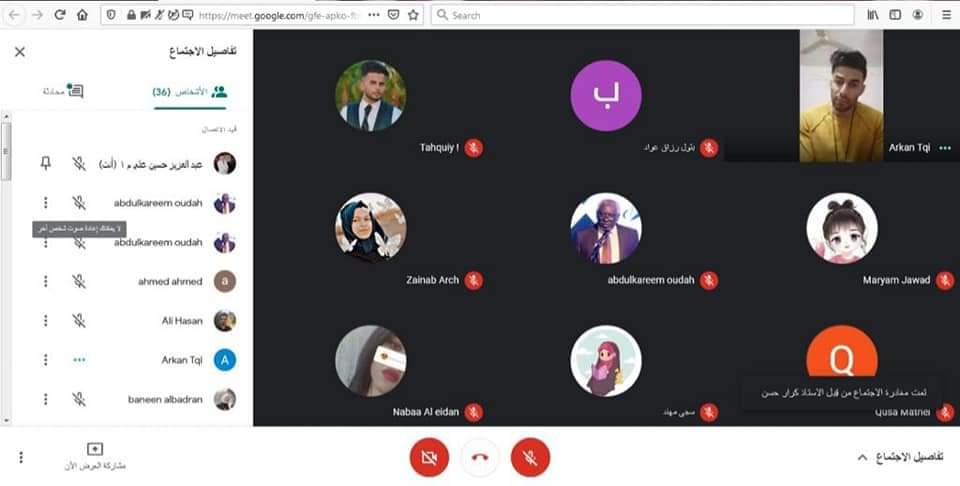
The Cultural Center organizes an open meeting for the news session and the press report
Media of the cultural center
The Cultural Center at the University of Basra organized an open meeting for participants in the course of writing the news and the press report on the (google meet) platform) within the activities of the project (Our Youth Makers of Life) Phase II Post-Session Communication
The meeting, which was managed by a member of the supervisory committee, Mr. Abdulaziz Hussein, from Injaz Foundation for Development and Development, and lectured by the journalist staff Taqi, the course coach, aims to talk about the course with its theoretical and applied approach, which was held at the cultural center, which included familiarizing the trainees with the method of writing the press release, whose impact depends on what the report is and the skill of the journalist. He explained the components of the elements of the news, which included impact, change and convergence, and explained the editorial values of the news, which are (sincerity and objectivity. Neutrality) reinforced this explanation with examples and focused on the interaction of participants. He went on to explain the second phase of the course, which represents the participants' involvement in applied living in Basra Voice Radio, to see on the ground the nature of media work in the newsroom.
Then the field was opened for the supervisors of the course and the trainees by talking about the extent to which they benefited from the days of the course in its theoretical and applied parts, stressing that the days of the course constitute an important episode of identification and usefulness workshops with media work to start to the stage of opening the way for young people to participate in their efforts, capabilities and skills to move to the stage of work in radio and satellite in Basra.
The Director of the Cultural Center, Dr. Dr. Abdul Karim Abboud, said that the second phase of the project of our youth life-makers is a stage of communication and continuity with everyone despite the health conditions associated with the epidemic. Therefore, the choice of our communication came online and on virtual platforms in order to emphasize that we are looking for knowledge and communication alternatives in order to serve young people and provide them with knowledge to improve their skills and provide the opportunity for trainees in particular and other youth to learn about the nature of this important project adopted by the university for a better tomorrow for our youth, the makers of new life.