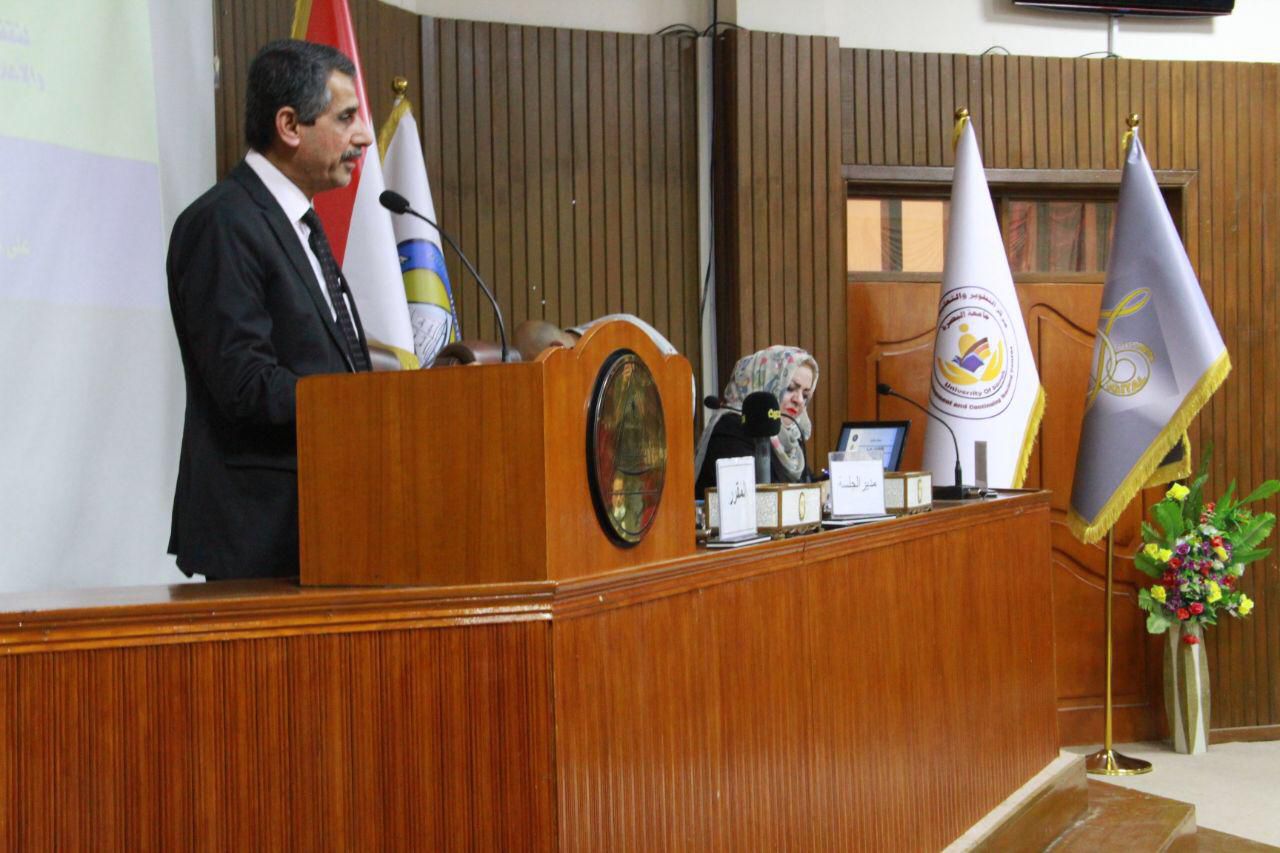
The Cultural Center, University of Basra, in cooperation with the Artists Syndicate, Basra branch, organized a seminar entitled (Our Culture to Where) today, Wednesday, 26/5/2021, with the participation of professors and heads of institutions, official organizations and civil society organizations concerned with culture and media on Marla Hall in the Bab Al-Zubair Colleges Complex
The seminar, which was moderated by the Director of the Cultural Center, Prof. Dr. Abdul Karim Abboud, any of the male and the wise national anthem, and the speech of the President of the University of Basra, Prof. Dr. Saad Shahine Hammadi, who stressed the role of the university in supporting culture in the city to achieve unified visions that bring together intellectuals, journalists, artists and writers and the advancement of visual culture. After this, the work of the symposium began, which included five interventions, the first of which was the academic side and a Dora in training and preparation, presented by the Dean of the Faculty of Fine Arts, Assistant Professor Dr. Ali Aboud Al-Kanani. The second intervention was for the President of Iraqi Artists, Basra Branch, Mr. Fathi Al-Shaddad, followed by the intervention of Prof. Dr. Majid Al-Jubour Bassem Al-Qatrani from the Union of Writers and Writers. After that, the door for discussion and dialogue was opened to put forward the views of the participants on how everyone moves one hand in order to improve the confidence movement. The Cultural Center organizes an open dialogue on awareness and opportunities for human development.
Media of the cultural center
Within the third phase program, the Cultural Center at the University of Basra held the second open dialogue on awareness and opportunities for human development in cooperation with INJAZ Foundation for Development and Development on a platform.
googal.meet
The dialogue presented by Prof. Dr. Tesser Al-Alusi, President of Ibn Rushd University in the Netherlands, aims to talk about awareness and opportunities for human development.
Al-Alusi touched on the most important basic pillar is education and the love of the homeland, which in turn contributes to building society and addressing awareness of its kinds, including contemplative, normative, moral, political and collective. It is related to behavior and theoretical or cognitive awareness. The need for a knowledge and real awareness towards decision and direction with the area of awareness. Collective awareness with the solidarity of efforts is the fusion between the conscious people.
He added, how to understand consciousness in a mature way and transfer it to the recipient, and how human development contributes to positive theorizing, the basics of building awareness, providing the basic basis for human development, and staying away from cases of psychological refraction and frustration that produce failure.
Prof. Dr. Abdul Karim Abboud Odeh said, "The third phase of our youth project, the stage of Arab and global openness, is launched in the space of youth awareness to diagnose the real alternatives with awareness, controversy and objectivity, which gave great momentum in our project, which carries what is inside it and defends clear, human and knowledgeable rights. We look at young people with the energy of the future as they make life in the city of Basra.
The Director of the Cultural Center, Abdul Karim Abboud, stated that the symposium aimed to study the reality of culture in the city of Basra and to seriously search on entrances to draw a clear road map in which all intellectuals contribute to a cultural movement that establishes a better future, while emphasizing the role of the university in opening up to society in cooperation with the Artists Syndicate and other parties to promote this strategic goal, in which we will all turn culture into a constructive victory for society.
In the end, the final statement and the recommendations formulated by a professional committee were read, which followed the proceedings of the symposium and reached a set of recommendations, the most important of which is paying attention to infrastructure and building cultural facilities representing the architecture of the city. The recommendation came to form a higher council for culture representing all relevant institutions and working to complete the plan of this council. The attendees also agreed to send a message to the decision-makers that will support the recommendations and mechanisms of their implementation in order to respond to work and creativity about the question of our culture to where