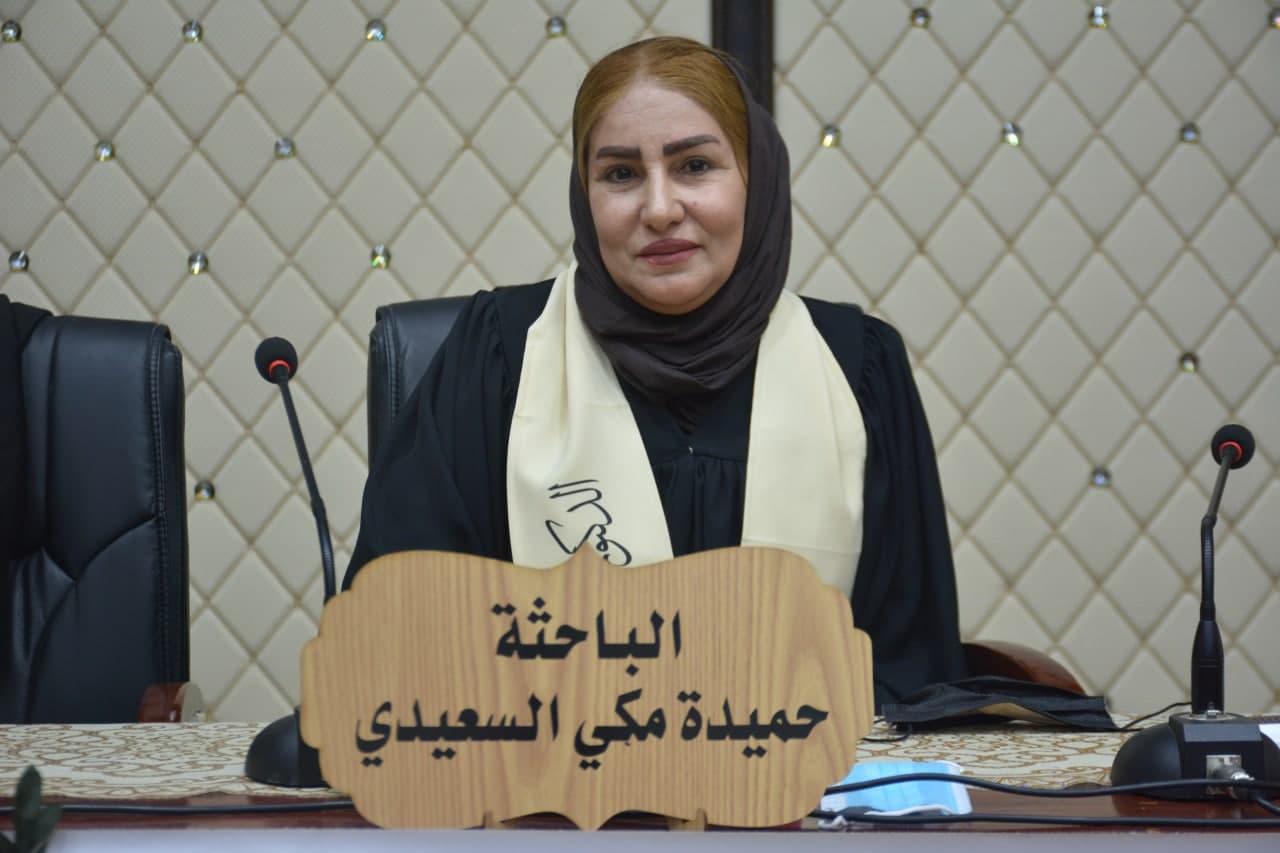
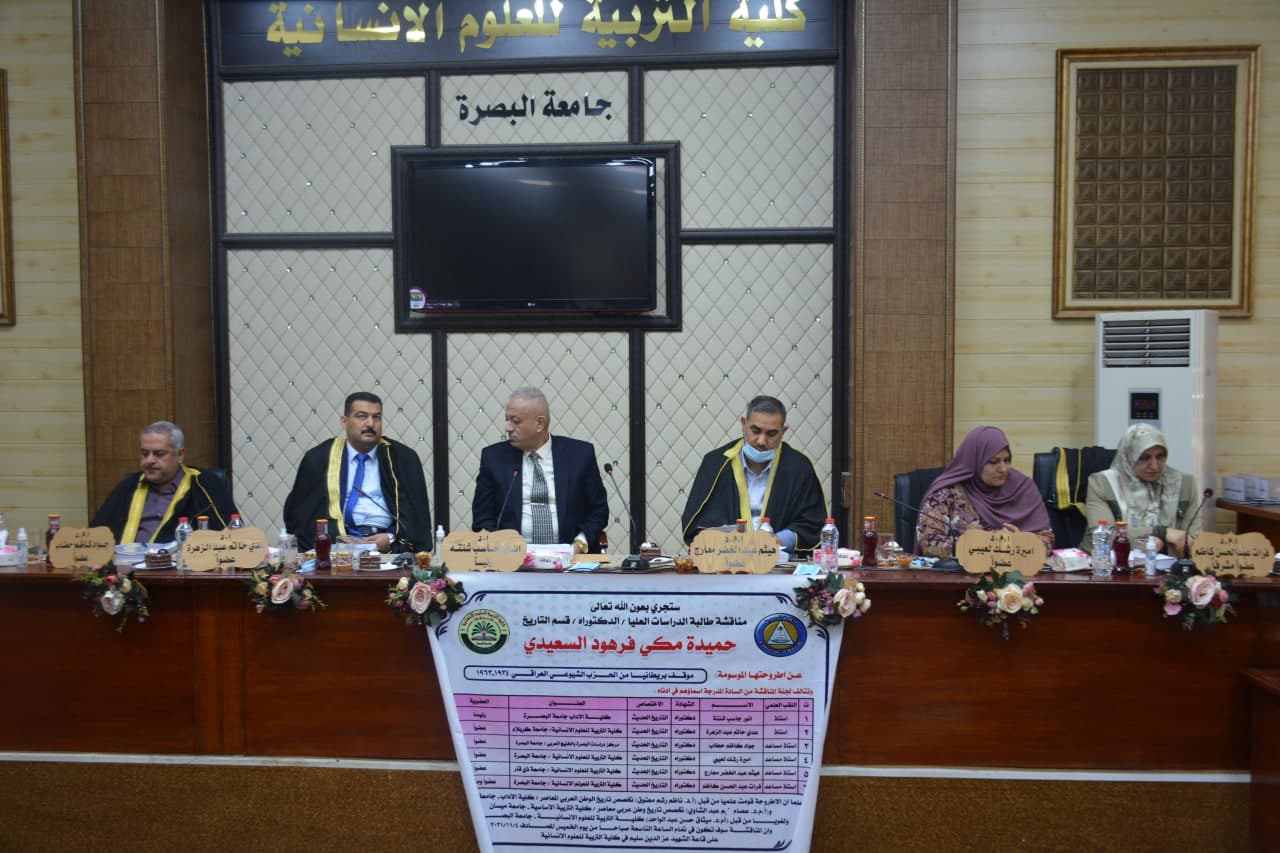
Researched a doctoral thesis in the Department of History, College of Education for Human Sciences, University of Basra (Britain's position on the Iraqi Communist Party 1958-1963), by the student (Hamida Makki Farhoud Al-Saidi).
The thesis dealt with a study on the British position on the Iraqi Communist Party for the period from 1934 until 1963, with the aim of revealing and clarifying its position on the party, the nature of the measures taken by successive Iraqi governments regarding the activity of the Communists in Iraq, Britain's position on these procedures, and the methods that Britain used to limit From the spread of communist ideas in Iraq.
The thesis includes an introduction, a preface and four chapters with a conclusion in order to cover all the activities of the Communist Party in Iraq and the procedures of successive Iraqi governments towards them and Britain's position on them during the period under study.
The preface came under the title (The Emergence and Spread of the Ideology of the Iraqi Communist Party), in which we studied the entry of Marxist ideas into Iraq, and the means that helped in their entry and spread. Britain from the founding of the Iraqi Communist Party and its activities, role and attitudes towards the events that Iraq experienced at that stage.
While the second chapter was entitled (The development of the activity of the Iraqi Communist Party 1946-1958 and Britain’s position on it), which sheds light on Britain’s role in eliminating the leaders of the Iraqi Communist Party, and its position on its activities for the period from 1946 to 1949, and its reactivation for the period from 1950 to 1953, As well as the party conferences that were held in the period from 1954-1957.
As for the third chapter, it came under the title (Britain’s position on the activity of the Iraqi Communist Party during the July 14 Revolution and the growing internal conflict 1958-1959) showing Britain’s position on the Iraqi Communist Party’s participation in the July 14, 1958 revolution, its attempts to control the street, and the outbreak of the national conflict The Communist Party for the period from 16 August 1958 to 15 December 1959.
The fourth chapter, entitled (Actions of Abdul Karim Qassem’s government towards the Iraqi Communist Party 1960-1963 and Britain’s position on it) after the issuance of the Associations Law and Abdul Karim Qassem’s claim to annex Kuwait, the outbreak of the Kurdish armed movement and the coup of February 8, 1963.
The thesis concluded the following: 1- A number of factors led Iraqi intellectuals to become aware of the socialist ideas that dominated the world at the beginning of the twentieth century. 2- Several factors hindered the spread of communism in Iraq. 3- The party has made a number of mistakes since its establishment that affected it in what After, 4- The Communist Party in Iraq, after the revolution of July 14, 1958, entered a new phase and became one of the most important issues that raised Britain’s concern. 5- The Iraqi Communist Party was unable to confront the coup movement on February 8, 1963, due to its preoccupation with side conflicts, 6- It did not Britain interfered with the Baathist authority after the February 8, 1963 coup, to influence the activity of the Iraqi Communist Party; due to his fading out.