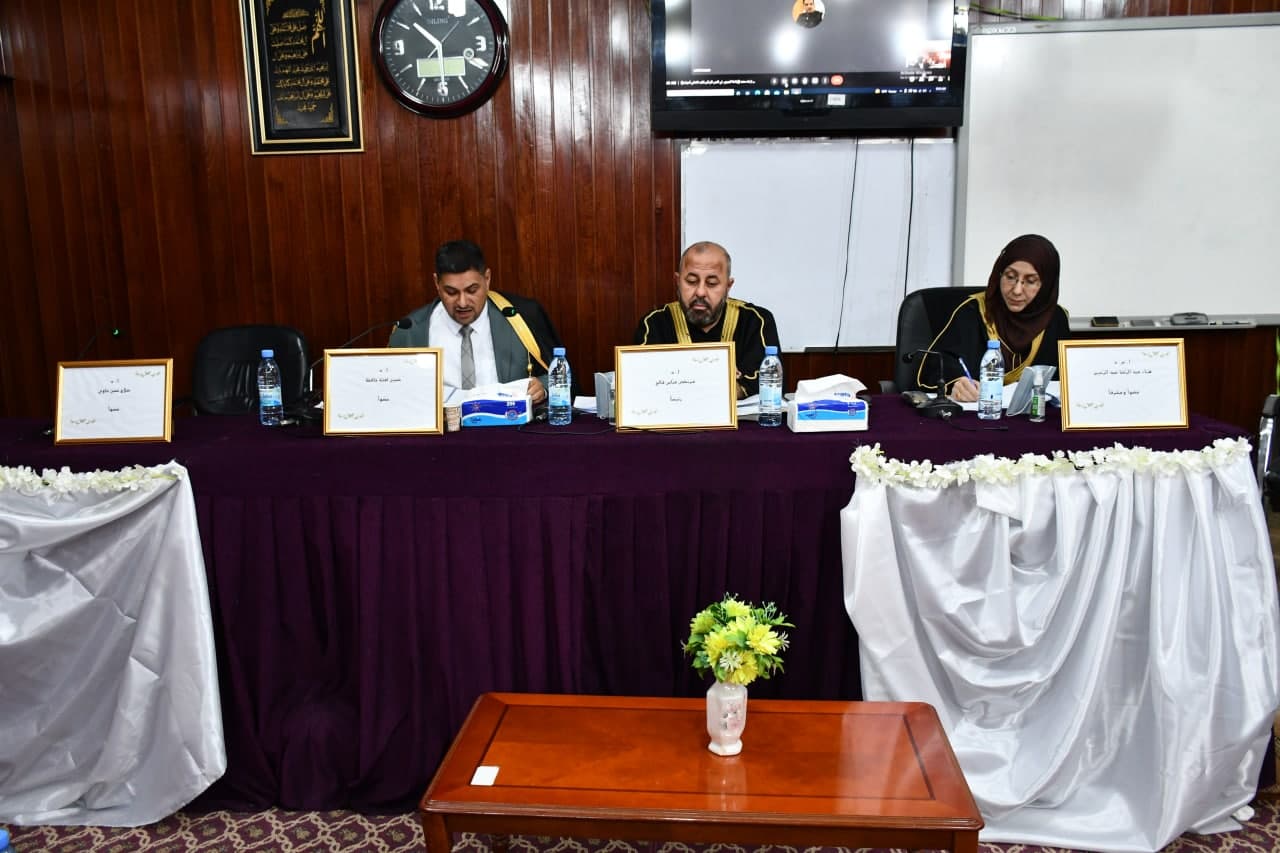
The Master’s thesis in the Department of Arabic Language / College of Education for Human Sciences / University of Basra examined (The Rhetoric of the Audience in the Heritage Text, The Book of Songs as a model) by the student (Mays Furat Muhammad).
The idea of choosing the subject of the tagged study (public rhetoric in the heritage text, the book of songs as a model) came in an attempt to reach the possibility of applying audience rhetoric to heritage texts after the success of the experiment with modern texts was proven. The book we chose is the Book of Songs by Abu Faraj al-Isfahani (d. 356 AH), which is considered one of the richest literary encyclopedias from which we can derive good responses to the audience, as the texts of this heritage treasure were recited or sung in front of a different audience, and this audience often had a voice An effective echo, and this voice plays an important role in bringing about change, bringing benefit, or repelling harm, or establishing something, or destroying it, and it has a great importance in effecting and being affected. The descriptive analytical method is the research method adopted in the study.
The material and nature of the study necessitated that it be divided into three chapters preceded by a preface showing the stages that the rhetoric passed through from its interest in the addressee to directing its attention to the audience. Interactive audience responses. The study concluded with the most important findings.
The study concluded: that the bellies of the heritage texts are full of good responses to the audience, whose rights have not been given so far; Due to the lack of studies that research this matter, and that the public of its various types is not just a group of individuals gathered in one place only, but each member of the public can constitute an intellectual and cultural force that stands in the face of those who try to dominate it physically, mentally, and intellectually.