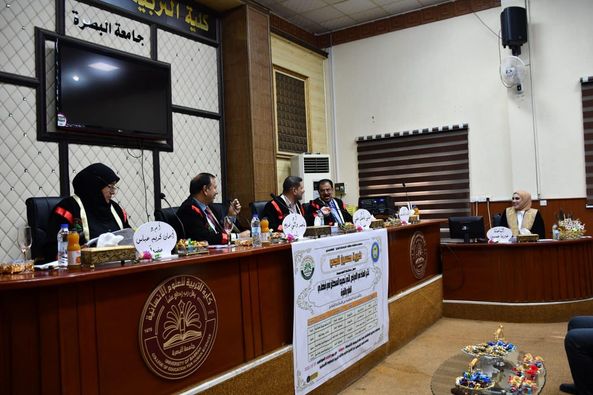
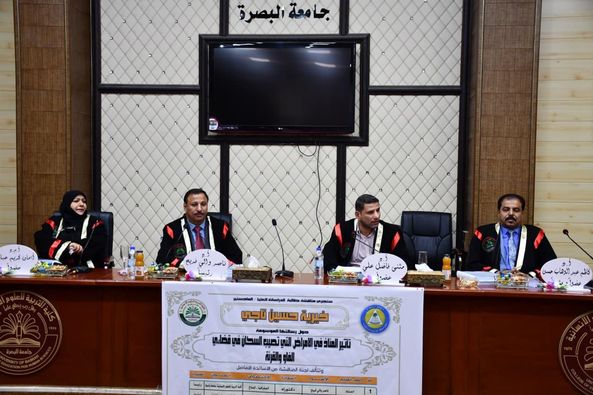
A master's thesis at the University of Basra discusses (the effect of climate on diseases affecting the population in the districts of Al-Faw and Al-Qurna)
A master's thesis in the Department of Geography, College of Education for Human Sciences, University of Basra, examined the effect of climate on diseases that afflict the population in the districts of Al-Faw and Al-Qurna, by the student Khairiya Hussein Naji.
The thesis dealt with the impact of climate on diseases that afflict the population in the districts of Al-Faw and Al-Qurna by showing the temporal and spatial variation of climatic elements and phenomena and their impact on the incidence of diseases (respiratory system, joints, skin), and the extent of the relationship between elements and climatic phenomena and the diseases under study and finding a relationship link to it.
The thesis included a study of the climatic elements affecting the study area represented by actual brightness, temperatures, relative humidity, wind speed and direction, and rain. Respiratory diseases and their types were analyzed, and the statistical relationship between respiratory diseases and climatic elements. Diseases of the musculoskeletal system and tissue were discussed. Damage in terms of its types and the statistical relationship with climatic elements.
Finally, the thesis showed skin diseases and the statistical relationship between skin diseases and climatic elements and phenomena.
The thesis concluded that there is a spatial and temporal discrepancy in the number of people infected with the diseases under study, as it turned out that there is a clear effect of climatic elements through increasing or decreasing the number of infected people, as the study showed that there is an effect of the rate of temperature in terms of its rise or fall, as it showed that there is An inverse relationship between temperature and joint diseases, as it showed an inverse relationship with diseases of the respiratory system, and it was also shown that dust phenomena had an effect on people with respiratory diseases, and it was also clear their relationship with some skin diseases, and it was found that humidity and rain had a relationship with some of the studied diseases in terms of increasing Number of injured or less