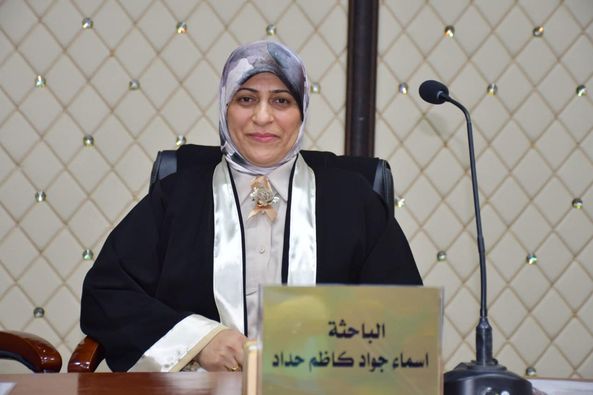
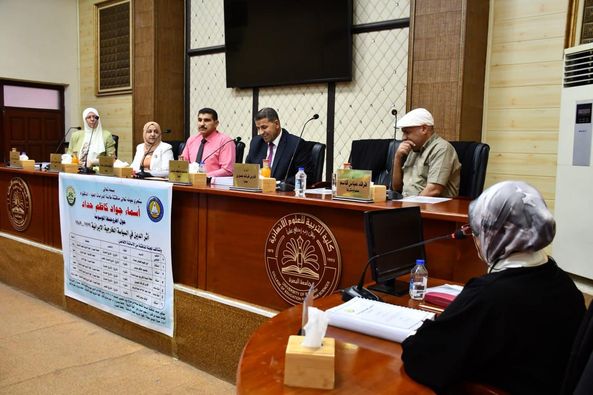
PhD thesis in the Department of History / College of Education for Human Sciences, University of Basra - The Impact of Religion on Iranian Foreign Policy 1979-1989 - for the student (Asmaa Jawad Kazem Haddad)
The thesis dealt with (The Impact of Religion on Iranian Foreign Policy 1979-1989) and was divided into an introduction and five chapters, followed by a conclusion and appendices. The first chapter dealt with: "The impact of religion on shaping the structure of the political system and determining its orientations at the internal and external levels in Iran 1962-1979", and the second chapter: "Religious ideology and its impact on the orientations of Iranian politics towards neighboring countries (Iraq-Turkey) 1979-1989", and the chapter The third: "Religious ideology and its impact on Iranian policy orientations towards the countries of the Arab East (Syria-Lebanon and Palestine) 1979-1989", and the fourth chapter: "The religious dimension in Iran's foreign policy towards the Arab Gulf states (Saudi Arabia, Bahrain) 1979-1989" , and Chapter Five, “The Religious Dimension in Iran’s Foreign Policy towards the Great Powers (Soviet Union-United States of America) 1979-1989.”
The thesis aims to give the reader a clear picture of the importance of that important period in Iran's political history, and the changes it brought in the international arena during that period. Despite the large number of academic and scientific studies in Iraq and even the Arab world on Iran's foreign policy, the religious aspect did not receive a single study in itself. Everything that was written about religion during that period was mentioned in a superficial manner, and it did not delve into the impact of religion on foreign policy
The thesis concluded that Iran's foreign policy is nothing but a product of a revolutionary ideology adopted by the religious elites after the Islamic Revolution in Iran in 1979, striving to export the Shiite sect, in an attempt to lay a strong foundation for the establishment of a global Islamic state, which has no specific borders through the application of the theory of the guardianship of the jurist . It turned out that Khomeini, the Supreme Leader in Iran, wanted during the period (1979-1989) to follow an expansionist policy towards the countries of the world, especially the neighboring and regional ones of his country, through what he called the support of all the oppressed and oppressed Muslims in the whole world