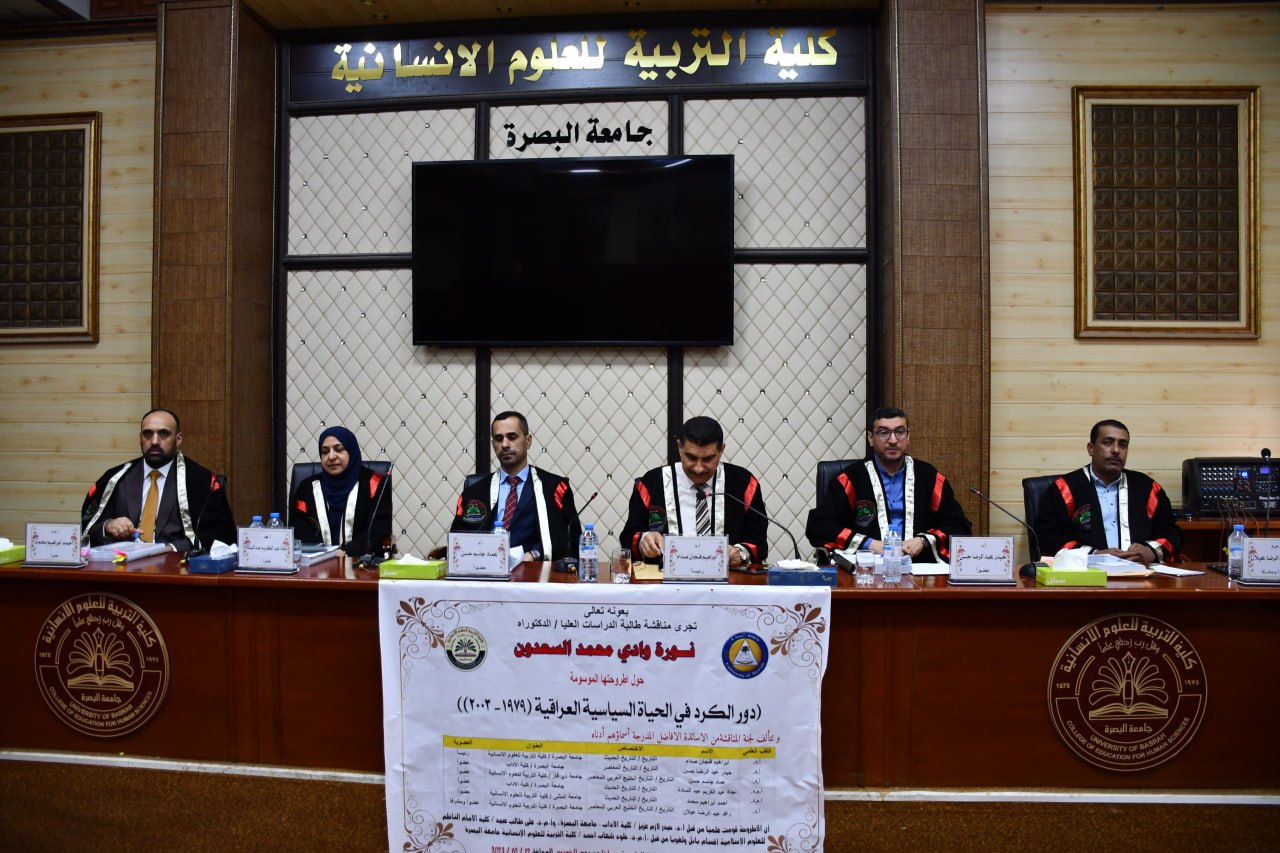
A doctoral thesis was discussed in the Department of History - College of Education for Human Sciences - University of Basra on (the role of the Kurds in Iraqi political life 1979-2003 - by the student (Noura Wadi Muhammad Al-Saadoun))
The thesis dealt with (the role of the Kurds in Iraqi political life 1979-2003) according to the study plan consisting of five chapters, as the first chapter was titled (the political and military activity of the Kurdish movements in Iraqi Kurdistan during the period 1921-1979), while the second chapter was entitled ( The political transformations and their impact on the direction of the Kurdish movements in Iraq during the period 1979-1985), while the third chapter shed light on (the Kurdish armed clash with the central government during the period 1985-1990), while the fourth chapter focused on (the political situation of the Kurds after the Second Gulf War 1991-1998), while the fifth and final chapter came to define (the internal, regional and international policy towards the Kurdish issue during the period 1998-2003).
The thesis aims to reveal one of the important and main aspects in the contemporary history of Iraq, which is an attempt to study the role of the Kurds in Iraq during the Iraq-Iran war, which lasted for eight years from 1980-1988, and the resulting retaliatory operations by the Iraqi government aimed at subjecting Kurdistan to the authority of the central government, as well as A study of the period after the invasion of Kuwait in 1990 and the resulting secession of the governorates of Iraqi Kurdistan from the authority of the central government and the entry of the Kurdish region into a civil war, as well as a study of the regional support (Iranian - Turkish - Syrian) for the Kurdish parties and the international role played by the United States of America in bringing the parties closer together. Kurdish language in preparation for the occupation of Iraq on March 20, 2003.
The thesis concluded that (the Kurds in Iraq did not have a unified, clear-cut policy through which they could seize the opportunity of the important political transformations that occurred in the regimes of Iran and Iraq, and that the Iraqi government was not honest in negotiating with the Kurds, but rather wanted, through the negotiations, to limit... External support and guaranteeing the Kurdish parties’ side in the Iran-Iraq war, in addition to that, the Kurdish opposition parties did not need an external force to solve their pending internal problems with the central governments as much as they needed a national project with high credibility, enabling them to obtain many of the legitimate rights of citizens. Kurds.