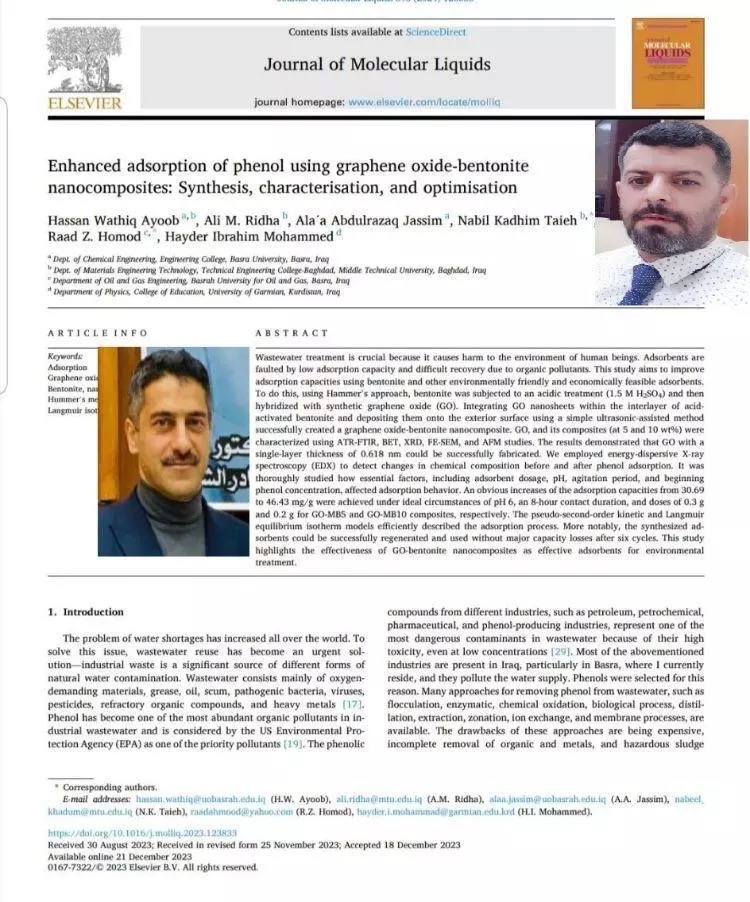
Publishing a joint scientific research by two teachers at University of Basrah in a reputable international journal
Dr. Alaa Abdul Razzaq Jassim and the lecturer Hassan Wathiq Ayoub at the College of Engineering at University of Basrah published a research entitled Enhancing adsorption of phenol using graphene bentonite oxide nanocomposites. Synthesis, characterization and improvement.
The study, which was published in the Journal of Molecular Liquids, which is considered one of the most prestigious journals in the field of chemical engineering and nanomaterials classified within the Scopus containers, included the random discharge of non-biodegradable organic pollutants, such as phenol, from human and natural sources in huge quantities into the aquatic environment. It is extremely dangerous for human health and the environment. The adsorption process is considered effective, economical, and the simplest water treatment technology. The use of appropriate adsorbents plays an important role in the adsorption capacity. Therefore, the study focused on the use of effective, abundant, cheap and environmentally friendly absorbent materials such as bentonite. Iraqi bentonite was improved by treating it with concentrated sulfuric acid and then hybridizing it with graphene oxide, which was prepared by the Hummer method. The graphene oxide-bentonite nanocomposite was prepared by inserting graphene oxide nanosheets into the activated bentonite layer in an easy way, which is using ultrasound waves. The adsorbents were examined using an infrared spectrometer (ATR_FTIR), a surface area calculator (BET), an X-ray diffraction device (XRD), a scanning electron microscope (FE_SEM), and an atomic force microscope (AFM). We also used energy dispersive X-ray spectroscopy (EDX) to detect changes in the chemical composition before and after phenol adsorption.
The results showed that graphene oxide was successfully prepared with a single layer thickness of 0.618 nm. The results also showed an increase in the surface area from 20.992 m2/g for raw bentonite to 184.312 m2/g for the hybrid compound.
The phenol removal efficiency was studied under different conditions including adsorbent dosage, pH, contact time and initial concentration. The adsorption efficiency under optimal conditions was 99.926%.
Department of Media and Government Communication