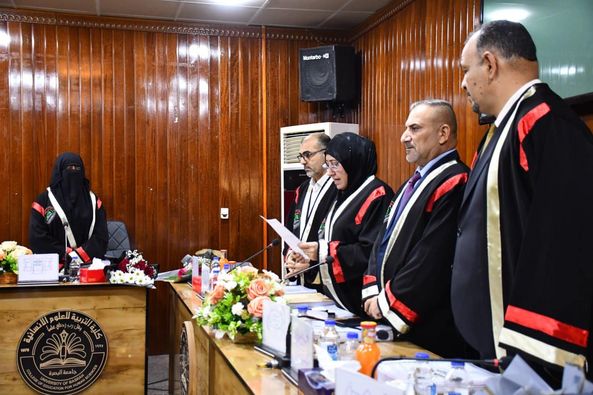
Discussing his doctoral thesis at the University of Basra ((The political journalistic column in Al-Sabah, Al-Mada and Al-Zaman newspaper, a study according to Al-Hajjaj’s theory from 6-10-2014 to 10-17-2017)). In the Department of Arabic Language / College of Education for Human Sciences, University of Basra, by the student (Huda Kazem Issa Al-Musawi) on Sunday: 14/11/2023 AD, corresponding to: 27 / Rabi’ al-Akhir / 1445 AH. Q:
Based on the rapid and sudden changes occurring in the Iraqi political arena and in view of the major role played by the Iraqi media, including the written press; Especially the newspaper column, the thesis dealt with three important pillars in the life of the Iraqi person in our contemporary reality, which are pilgrims, politics, and the press. This study aims to reveal Al-Hajjaj’s mechanisms and their role in persuading the reader and influencing him to change his behavior in a way that is consistent with the nature of the visions and ideas presented by the political journalistic columnist in the Iraqi political newspapers: Al-Sabah, Al-Mada and Al-Zaman - Iraq edition -. Given the lack of academic linguistic studies in our Iraqi universities that take political topics as a field for research and study; It is necessary for both linguistic and rhetorical academic research to take these steps in order to achieve a presence in the interaction with political events and to employ language in a manner that is in harmony with the spirit of the times and the taste of the masses. Change is a universal year. The research steps were divided into an introduction, an introduction, and six chapters: In the introduction: The research dealt with politics and journalism and the close relationship between them, the common language, the advantages of the political journalistic column, the advantage of its writers, and a set of characteristics that distinguished each newspaper based on the controls and politics it imposes on its writers and the reflection of that. To employ pilgrimage mechanisms. The first chapter was devoted to presenting and analyzing examples of newspaper columns and revealing the importance of the argumentative link in them, and the extent of accuracy in selecting and employing it and paying attention to the lexical vocabulary that connects them. It was divided into five sections: the syncretic argumentative link, the oppositional argumentative link, the literal explanatory link, the lexical explanatory link, and the link. The second chapter focuses its attention on the argumentative factor through selected examples of political newspaper column articles, how to employ it, and the argumentative energies that it adds to the article, making it a completely different mechanism from the argumentative link. It was divided into four sections: negation, shortening, condition, and affirmation. In the third chapter, the study focused on explaining the role of the argumentative ladder structure and the extent of its ability to influence and persuade the reader. This was divided into two sections: The first section dealt with a presentation and analysis of the links and factors and their mutual support to build the argumentative ladder. The second section was devoted to studying the structural structures that support the construction of the argumentative ladder. The fourth chapter covers two aspects, divided into two sections: The first section is the argumentative description, which focuses on the word; It is a complete description that clarifies and explains what it presents, and gives the context in which it is presented argumentative energy that increases the possibility of convincing the reader. As for the argumentative indicator study, it was concerned with studying and analyzing the argumentative linguistic indicators that are not self-sufficient, but rather need others.
As for the fifth chapter, it dealt with the linguistic witness and revealed its argumentation in the political column. It was divided into three sections: the Qur’anic witness, the poetic witness, the eloquent proverb, and the famous speech about the Arabs.
In the sixth chapter, the research directed to studying the Iraqi dialect published in column articles, analyzing it, and explaining its arguments in three sections: the dialect vocabulary and the places in which it is used and employed argumentatively. The second section dealt with the structure in two topics: the dialect structures circulating in the language of the people, and the second dealt with the popular proverb. The study reached results, the most important of which are: - Revealing About the nature of political discourse and its features in each newspaper.
Pilgrimage is a social activity directed towards others to encourage them to take action and change their point of view. Based on what the arguments put forward. The political columns appeared in metaphors, metaphors, satirical literature, colloquial vocabulary, and constructions. Therefore, if we try to describe the columns as literary, then they are second-class literature.
- Employing the most common argumentative link on the tongues of the public, and in easy, eloquent language that is compatible with the spirit of the times, such as: (the result of that, the evidence for that, the evidence, the reason), and this is closer to the reader’s taste and faster in understanding and interacting with the writer’s intentions and goals. The research revealed the argumentative link introduced into the contemporary language in the language of journalism through translation, such as: and (therefore).
- In constructing the argumentative consonants and linking them using conjunctions (waw, even, then), the study revealed that they are a prominent feature in the language of daily use. Which makes political argumentative discourse attract the largest number of readers. The gradual presentation of ideas is consistent with the nature of the communication process between people in the various affairs of their lives.