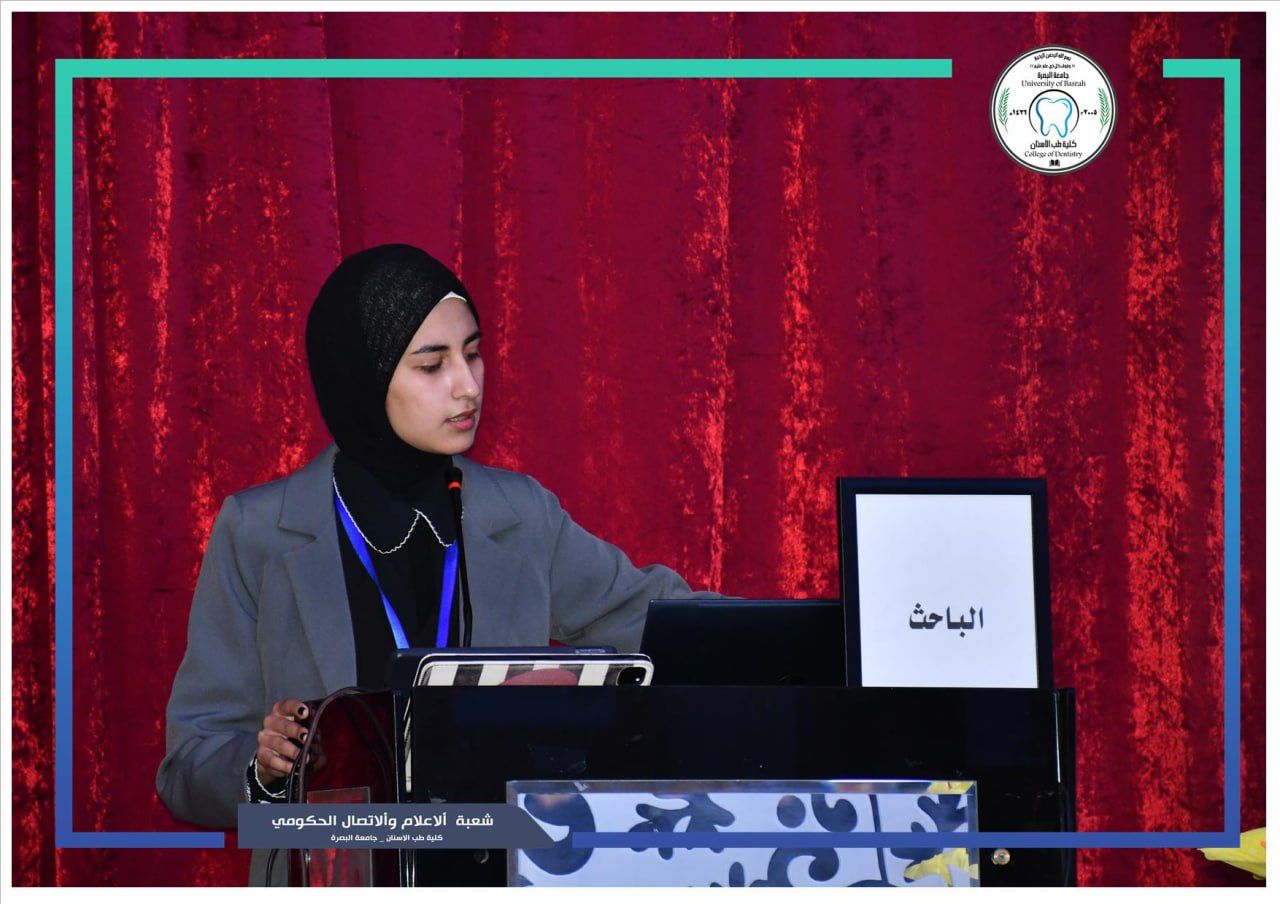
The College of Dentistry at the University of Basra held the first dental conference (Science and Innovation), where researcher Fatima Al-Zahraa Haider Abdel-Razzaq presented the research entitled A Technical Review of Applications and Analysis of Biological Materials in Criminal Investigations. The research referred to the topic of the lecture on the analysis of biological evidence in the field of forensic sciences, reviewing the general structure of the research. It aims to review and analyze various biological evidence and its importance in criminal investigations.
The structure of the research includes an introduction and four main sections. In the first section, the focus is on forensic analysis of blood, where an introduction to blood is provided with an emphasis on its importance in criminal investigations, and the techniques used in blood analysis are presented in addition to cases of its use in solving crimes. The second section focuses on the forensic analysis of saliva, providing an introduction to it and clarifying its importance in criminal investigations, in addition to reviewing the techniques used in saliva analysis and presenting cases of their use in solving crimes. The third section deals with forensic analysis of semen, with an introduction to it, highlighting its importance in criminal investigations, and presenting the techniques used in semen analysis and cases of its use in solving crimes. The fourth section focuses on the forensic analysis of poetry, providing an introduction to it, clarifying its importance in criminal investigations, and presenting the techniques used in hair analysis and cases of its use in solving crimes.
The research reviews the importance of analyzing biological evidence in the criminal field, where the focus is on blood, saliva, semen, and hair. The research also addresses the methods and techniques used in analyzing each type of evidence, as well as the outcomes and challenges that forensic operations may face.
Conclusion:
The lecture demonstrates the importance of using biological evidence in solving crimes and identifying defendants, focusing on evidence such as blood, saliva, semen, and hair. The lecture also explains the techniques used in analyzing this evidence and the challenges that forensic operations may face.
