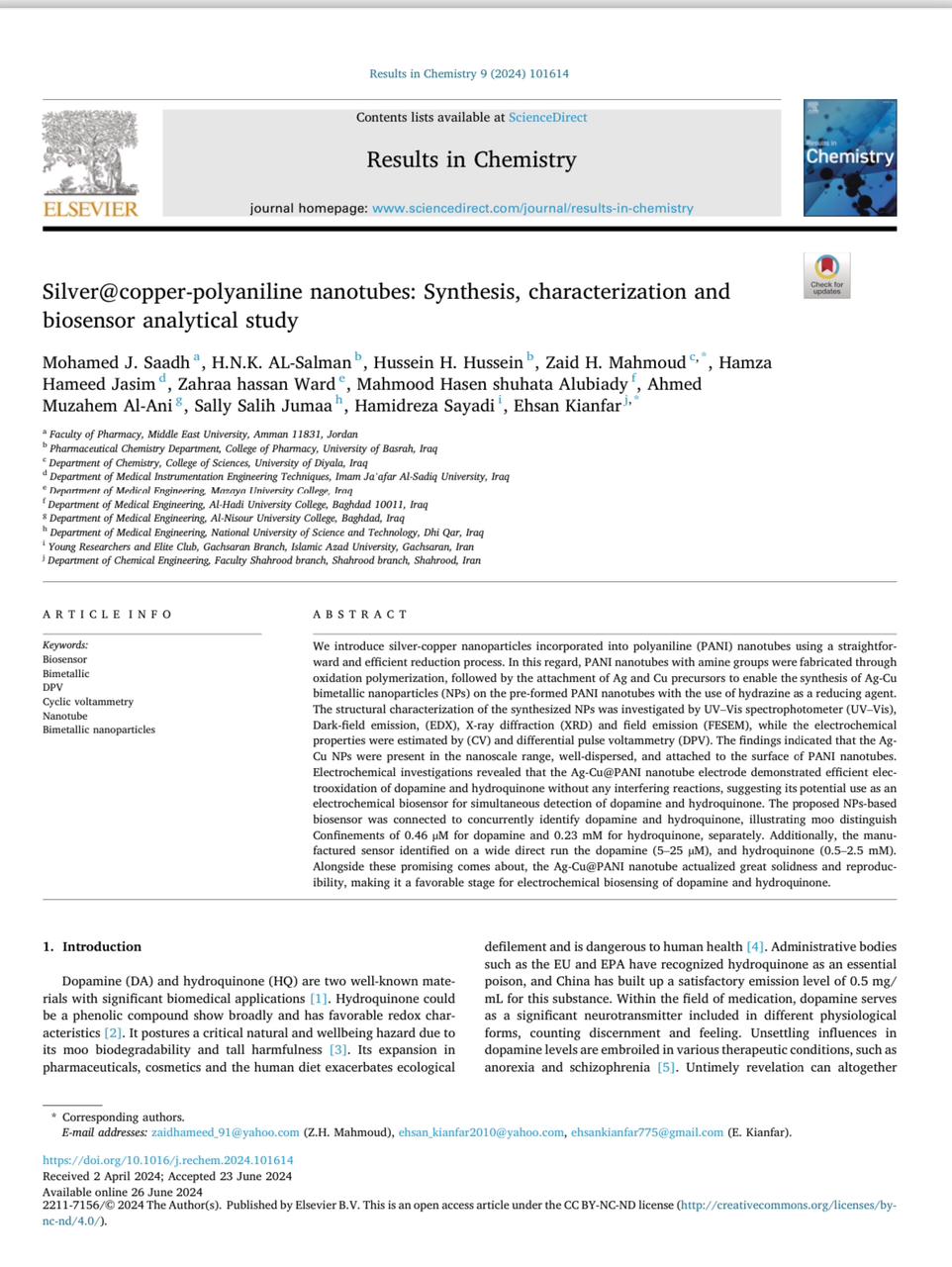
Dr. Hussein Nasser Khalaf, a faculty member at the College of Pharmacy, University of Basrah, published a scientific research titled "Silver, Copper, and Polyaniline Nanotubes: Synthesis, Characterization, and Analytical Study of Biosensor" in the Dutch journal "Results in Chemistry," indexed in Scopus.
The research involved the synthesis of PANI nanotubes with amine groups via oxidative polymerization, followed by linking silver (Ag) and copper (Cu) precursors to enable the synthesis of bimetallic nanoparticles (Ag-Cu NPs) on pre-formed nanotubes using hydrazine as a reducing agent.
Based on electrochemical tests, the research concluded that the nanotube electrode showed efficient electro-oxidation of dopamine and hydroquinone without interference, indicating its potential use as an electrochemical sensor for the simultaneous detection of both substances with precise discrimination of up to 0.46 µM for dopamine and 0.23 mM for hydroquinone.
Alongside these promising results, the synthesized nanotube achieved significant stability and high reproducibility, making it a favorable platform for advanced electrochemical biosensing of dopamine and hydroquinone in medical and analytical fields.