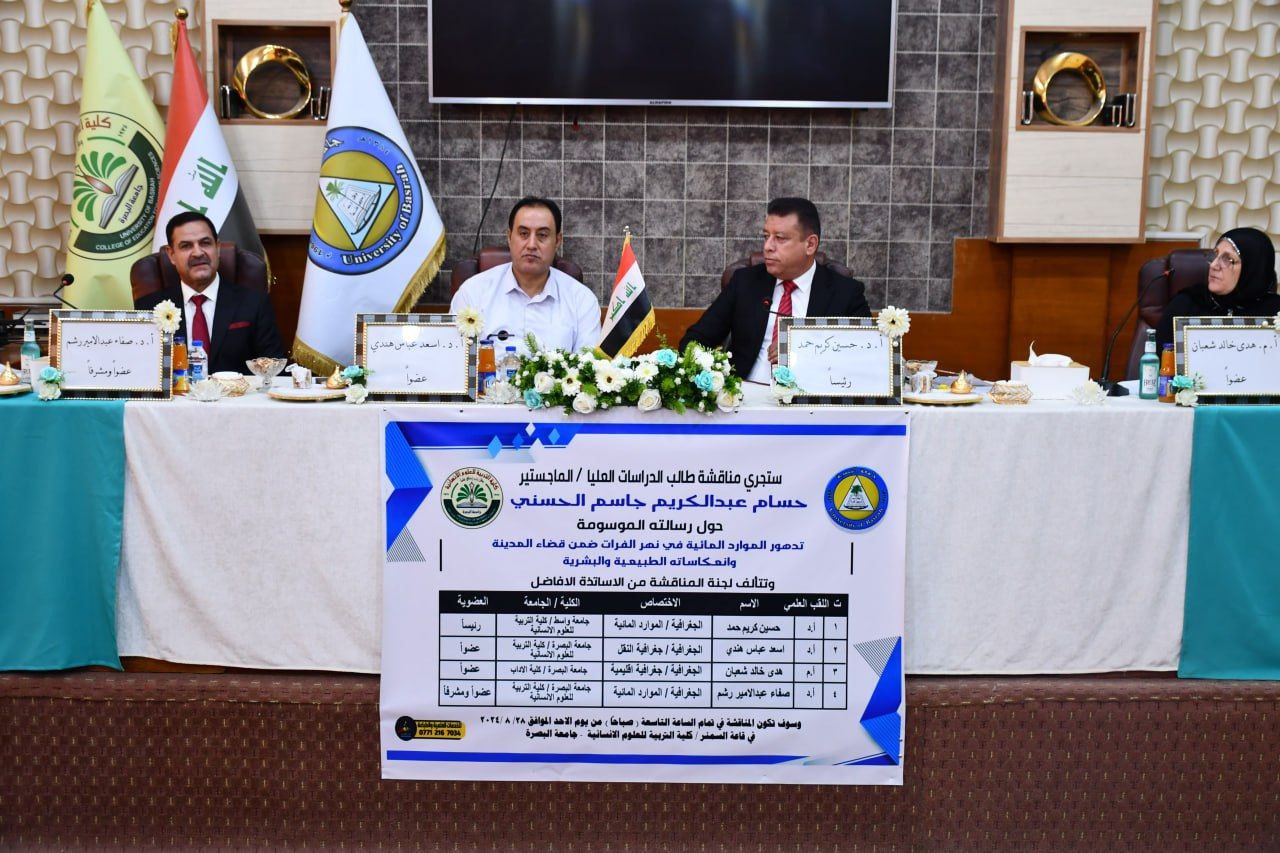
A master's thesis in the Department of Geography / College of Education for Humanities / University of Basra
(The deterioration of water resources in the Euphrates River within the city district, its natural and human repercussions) by the student (Hussam Abdul Karim Jassim Al-Hasani).
The thesis presented by the student Hussam Abdul Karim Jassim Al-Hasani aimed at the increase in the amount of total dissolved solids (TDS) in the Euphrates River waters at the stations (Al-Qaim, Al-Hindiya, Al-Nasiriyah, Basra) and the decline in the water discharge of the Euphrates River at the aforementioned stations, as well as the temporal variation of the main positive and negative ions in the river waters in Basra Governorate during the period (1970 - 2022).
The thesis included a study of the effects of the quantitative and qualitative deterioration of the Euphrates River waters in Basra Governorate on human health, aquatic life, agricultural production, the decline in fish wealth, the extinction of certain species of fish in the study area, the impact of deterioration on soil, migration, community security, and the effects of cutting off the Euphrates River from Basra Governorate in 2012.
The study concluded that the water discharge of the Euphrates River is characterized by fluctuations, with a general trend towards decrease, due to the hydrological projects established by Turkey and Syria on the river since the beginning of the nineties. The study concluded that climate changes directly affect the decrease in the sources of nutrition in the Euphrates River Basin, as precipitation has decreased due to climate changes through rising temperatures and increasing evaporation amounts. The study concluded that there is a direct relationship between the amount of discharge and the concentration of salts, as the amount of total dissolved salts (TDS) increases with the decrease in the amount of discharge and decreases as the amount of discharge increases, i.e. it is an inverse relationship. The study also concluded that the cutting off of the Euphrates River from the study area in 2012 by the Iraqi Ministry of Water Resources led to the population’s dependence on the waters of the Tigris River for their various uses