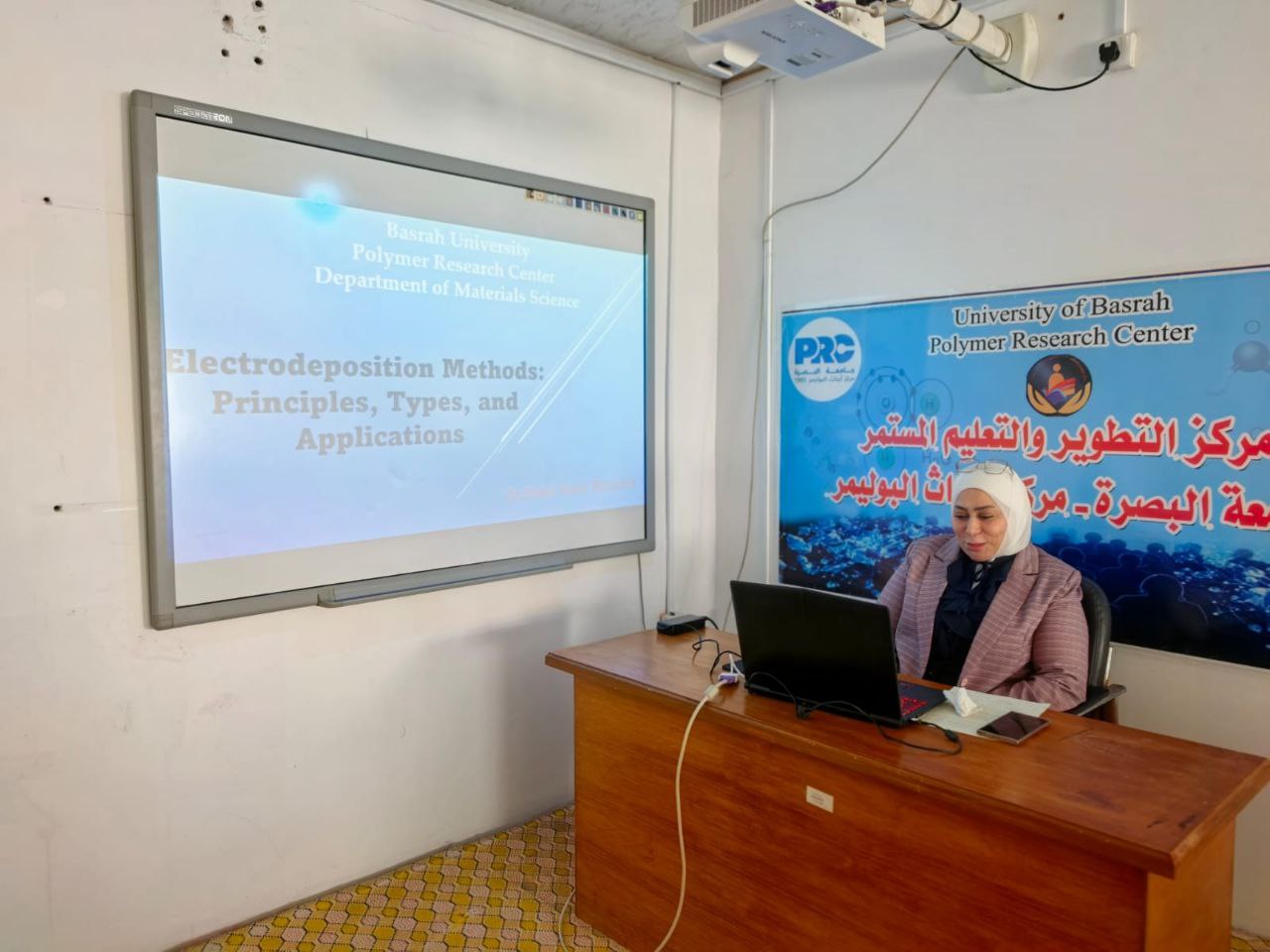
The Polymer Research Center at the University of Basrah held a workshop on the principles, types, and applications of electrochemical deposition. Presented by Dr. Dalal N. M, the workshop addressed the topic of electrochemical deposition, a crucial and versatile technique in materials science. Electrochemical deposition is used to create thin films and functional coatings on various surfaces through controlled electrochemical reactions. Its main types include cathodic deposition, anodic deposition, particle electrodeposition (EPD), pulsed deposition, and chemical deposition, which can be performed without an external power source.These methods allow for precise control over the thickness of the layers, particle size, composition, and microstructure, making them suitable for producing high-quality materials. The deposition process is affected by several operational factors, such as current density, electrolyte composition, pH value, and temperature. Chemical additives and deposition time play a pivotal role in determining the final properties of the deposited coatings. Deposition applications are numerous, including: corrosion protection, decorative coatings, microelectronics, energy storage devices such as batteries and capacitors, electrochemical protection, ultraviolet protection, chemical catalysis, nanomaterials fabrication, and metal recovery from industrial waste. This technology is characterized by its simplicity, low cost, industrial scalability, and compatibility with various substrate types. Current research trends focus on developing environmentally friendly methods, producing nano- and composite coatings, and improving energy efficiency, thus enhancing its importance in future applications.