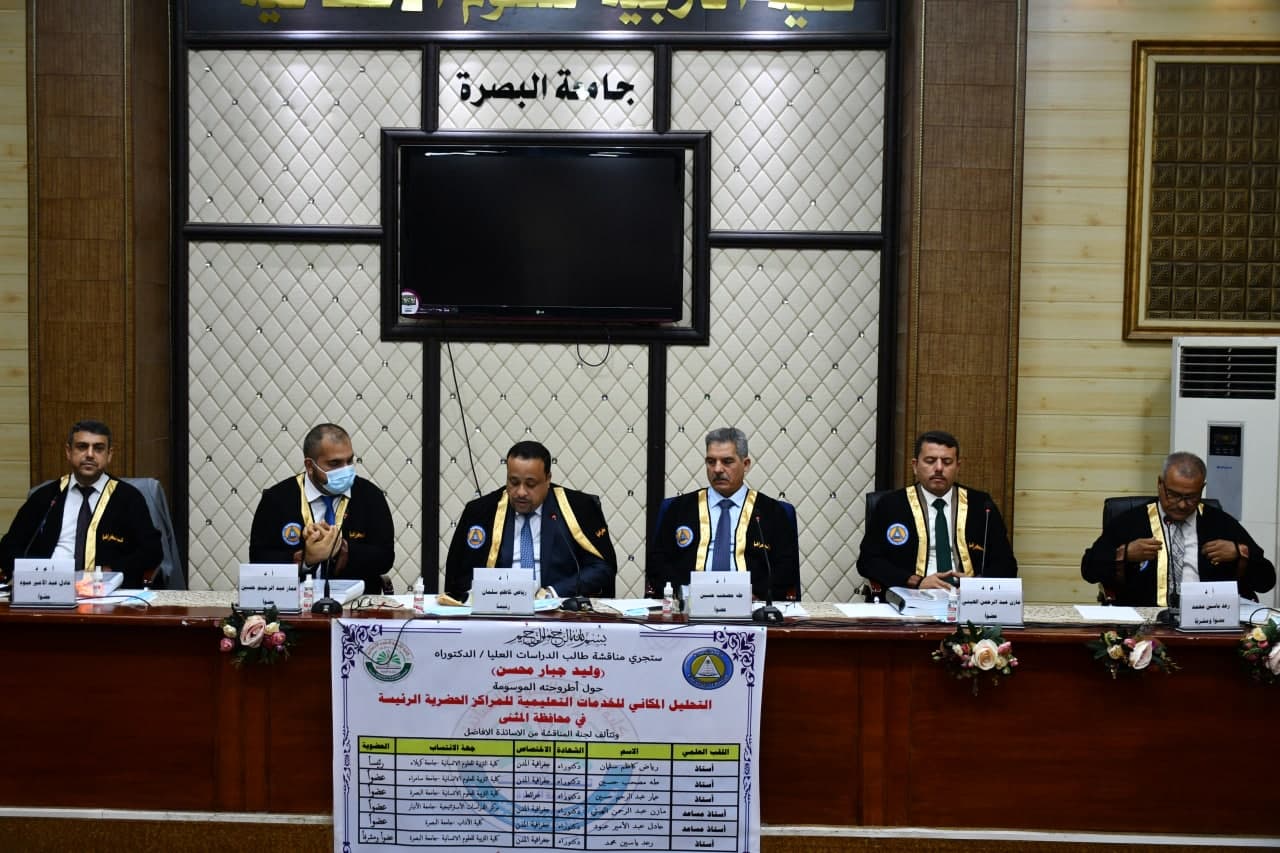
A doctoral thesis at the University of Basra discussing (spatial analysis of educational services for the main urban centers in Al-Muthanna Governorate).
In the Department of Geography / College of Education for Human Sciences / University of Basra / for the student (Walled Jabbar Mohsen).
The thesis dealt with the educational services of the main urban centers in Al-Muthanna Governorate, represented by (Samawah, Al-Rumaitha, Al-Khader), as the thesis contained four semesters preceded by an introduction. For educational services, while the third chapter sheds light on the efficiency of educational services compared to the planning standards of the country, and the fourth chapter focused on the most prominent problems facing educational services and their current and future needs, and concluded the study with a set of results and suggestions, as well as a list of sources, references and supplements.
: The study reached a set of results, most notably
1- The study revealed a decrease in the efficiency of the (student / school) standard for kindergarten in the cities of (Samawa, Al-Rumaitha) compared to its height in the city (Al-Khidr) compared to the Iraqi planning standards, and its high for primary schools in the cities (Samawa, Al-Khader) compared to its low in the city (Al-Rumaitha) ) While the efficiency of schools (intermediate, secondary, vocational) increases in all study areas, but this efficiency varies from one neighborhood to another, as it rises in some and decreases in others.
2- The study showed the high or closeness of the efficiency of the (student/teacher) standard for kindergarten and vocational schools in all study areas and its decrease in middle schools compared to the Iraqi planning standards, while it rises in primary and secondary schools in the city of (Samawah) and decreases in the cities of (Al-Rumaitha and Al-Khidr). .
3- It was found that the efficiency of (student/section) is low in all study areas except for vocational schools that recorded efficiency rates better than the standard due to the small number of their students, and primary schools in the city of Samawa, which recorded an efficiency rate close to the Iraqi planning standards. This efficiency varies from one neighborhood to another. For all grade levels.
4- It became clear through the study that all study areas suffer from a deficit in the number of kindergartens according to the criterion (kindergarten / people), and a surplus in the number of primary schools according to the criterion (primary school / people), and this deficit and surplus varies from one district to another.
: The most important suggestions that came out of the study are
1- Increasing the number of school buildings in the study area by building new schools or completing unfinished and lagging buildings.
2- Increasing the number of educational and teaching cadres in the schools of the study area by appointing new cadres or contracting with free lecturers and converting them into ministerial contracts.
3- Redistribution of many educational services at the level of the districts of the study area, especially primary and secondary schools, which are concentrated in some districts and lack them in other districts.
4- Finding solutions to the problems that school buildings, teaching staff and students suffer from.